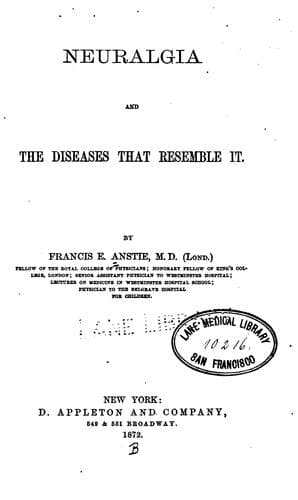
Neuralgia and the diseases that resemble it — John Shaqi
Neuralgia and the diseases that resemble itAnstie, Francis Edmund
Science
Neuralgia and the diseases that resemble it
Anstie, Francis Edmund
Neuralgia
It must not be supposed that there is a sharp line of demarcation
between this period and the last; nevertheless, there are certain
well-marked differences, both in their general tendencies, and as
regards the local varieties which are commonest in each. We shall
discuss the latter point farther on. At present, it is interesting to
remark on the general freedom of the busy middle period of life from
first attacks of neuralgia. A person who has had neuralgia previously
may, and very likely will, during this epoch, be subject to recurrence
of the old affection under stress of exhaustion of any kind. But it is
very rare, in my experience, for busy house-mothers or fathers of
families to get first attacks of neuralgia during this period of life.
It is not the way in which a still vigorous man's nervous system breaks
down, if it breaks down at all. Men frequently do break down, of course,
at an age when their tissues generally are sound enough, and there is no
reason, except on the side of their nervous system, why they should not
remain in vigorous health for years. But it is greatly more common for
the nervous collapse to take the form of insanity, or hypochondriasis,
or paralysis, then that of neuralgia. If a man has escaped the latter
disease during the period when the growth of his tissues was active, it
is not very often that he falls a victim to it till he begins,
physiologically speaking, to grow old.
4. _Neuralgias of Declining Bodily Vigor._--The period here referred to
is that which commences with the first indications of general physical
decay, of which the earliest which we can recognize (in persons who are
not cut off by special diseases) is perhaps the tendency to atheromatous
change in the arteries. The first development of this change varies very
considerably in date; but whenever it occurs it is a plain warning that
a new set of vital conditions has arisen, and especially notable is its
connection with the characters of the neuralgic affections which take
their rise after its commencement. The period of declining life is
pre-eminently the time for severe and intractable neuralgias.
Comparatively few patients are ever permanently cured who are first
attacked with neuralgia after they have entered upon what may be termed
the "degenerative" period of existence. I mentioned the existence of
commencing arterial degeneration as the special and most trustworthy
sign of the initiation of bodily decay; but it is needless to say that
this change is often not to be detected in its earliest stage. Something
has been done of late years, however, to render its diagnosis more easy.
Not to dwell upon the phenomenon of the arcus senilis, which though of a
certain value is confessedly only very partially reliable, we may
mention the sphygmographic character of the pulse as possessing a real
value in deciding the physiological status of the arterial system. There
is a well-known form of pulse-curve, square-headed, with marked
Public-domain text, read in full here on John Shaqi.
Reviews
Reviews
No reviews yet
Be the first to share your thoughts on this work.
Join the Discussion
Join the discussion
Sign in to leave a comment or review.
Sign InorCreate an account