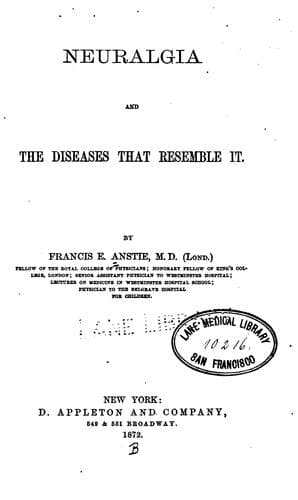
Neuralgia and the diseases that resemble itAnstie, Francis Edmund
Science
Neuralgia and the diseases that resemble it
Anstie, Francis Edmund
Neuralgia
Prolonged spastic contraction of voluntary muscles, going on, sometimes
for weeks, and even months, is a phenomenon that has often been
observed; it may attack the arm only, or may affect all the limbs, and
the muscles of the trunk and of the neck: it is for the most part
symmetrical, but is occasionally unilateral. It begins in the
extremities, and is very commonly limited to them; it is much more
gentle than tetanic spasm, and is also painless, or nearly so; but the
contraction is often strong enough to resist very vigorous efforts at
artificial extension.
Paralyses, both of bowel and bladder, have been recorded among the
occasional phenomena of spinal irritation with fixed tender points; but
I cannot say that I have ever seen such an occurrence. On the whole, I
must say that by far the most frequent phenomena of spinal irritation
that I have seen have been somewhat diffuse cutaneous or mucous
tenderness and irritability (without acute pain) and the presence of
tormenting arterial throbbings; also a marked tendency to aggravation of
some symptoms, especially the gastric, when firm pressure is made upon
the tender spinal points. For a further and fuller account of the
phenomena of spinal irritation I may refer the reader to the able
article of Dr. Radcliffe,[48] and the work of the brothers Griffin,
already quoted; adding the suggestion, however, that both these
authorities, and especially the Griffins, appear to me not to draw a
sufficiently clear distinction between the class of cases that I have
been attempting to describe and the true neuralgias.
After what has been said, there is no need to draw out a formal list of
the points of diagnosis between spinal irritation and neuralgia. It must
be admitted, moreover, that the two forms of diseases have a strong
connection in the fact that they are each of them most frequently
developed in the descendants of neurotic families. It is by the more
generalized character of the symptoms, and the absence of the tendency
to perpetual recurrence of paroxysmal pain in one definite nerve, that
spinal irritation is mainly distinguishable from true neuralgia. I may
add that there is a marked distinction, also, in the results of
treatment.
Public-domain text, read in full here on John Shaqi.
Reviews
Reviews
No reviews yet
Be the first to share your thoughts on this work.
Elsewhere in the archive
Join the Discussion
Join the discussion
Sign in to leave a comment or review.
Sign InorCreate an account