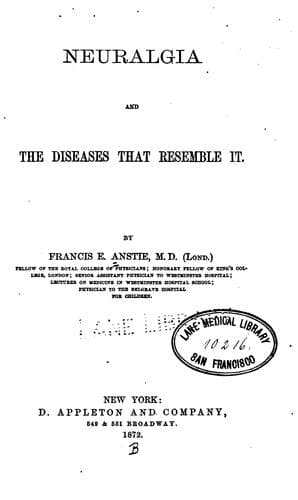
Neuralgia and the diseases that resemble itAnstie, Francis Edmund
Science
Neuralgia and the diseases that resemble it
Anstie, Francis Edmund
Neuralgia
Hypochondriasis is not insanity, if by insanity we mean intellectual
perversion dependent mainly or entirely on the state of the higher
nervous centres. But it is closely allied to insanity in its phenomena,
only that these are, as it were, manifested in a scattered form,
unequally distributed over the whole central nervous system, and
especially affecting the spinal sensory centres. And its radical
relationship to true insanity is strongly indicated by the fact that the
sufferers from hypochondriasis are nearly, if not quite, always members
of families in which distinct insanity has shown itself; indeed, more
often than not, of families which have been strongly tainted in this
way. In the majority of instances there are psychical peculiarities of a
marked kind which accompany or precede the development of the abnormal
sensations which form the especial torment of hypochondriacs. Without
apparent cause, they begin to evince a heightened self-feeling and an
anxious concentration of their thoughts upon the state of one or more of
their bodily organs. Or it may be that, before any such definite bias is
given to their thoughts, they simply become less sociable and more
self-centred, and are subject to fits of indefinite and inexplicable
depression, or at least to great variability of spirits. But before long
they begin to experience definite morbid sensations, most commonly
connected with the digestive organs, and very often accompanied by
positive derangement of digestion of an objective character; such as
flatulence, sour eructation, spasmodic stomach-pain, etc. Along with
these phenomena, or soon afterward (and not unfrequently before the
patient has acquired that intensity of morbid conviction of his having
some special disease which is afterward so marked a peculiarity of his
mental state), he very often becomes the subject of the kind of pains
which it is the special purpose of this chapter to describe.
Public-domain text, read in full here on John Shaqi.
Reviews
Reviews
No reviews yet
Be the first to share your thoughts on this work.
Elsewhere in the archive
Join the Discussion
Join the discussion
Sign in to leave a comment or review.
Sign InorCreate an account