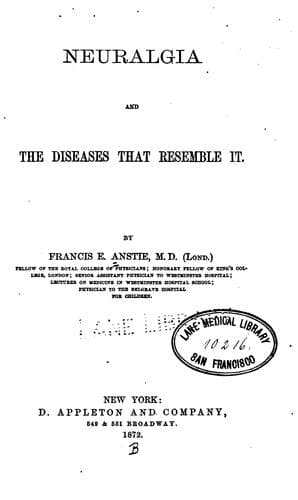
Neuralgia and the diseases that resemble itAnstie, Francis Edmund
Science
Neuralgia and the diseases that resemble it
Anstie, Francis Edmund
Neuralgia
The pains of hypochondriasis, when they assume any more definite form
than that of mere dyspeptic uneasiness, present many analogies with
neuralgia. They are not, usually, periodic in any regular manner, but
they have the same tendency to complete intermission, and they
frequently haunt some one or more definite nerves for a considerable
period of time. Of all nerves that are liable to this kind of affections
the vagus is undoubtedly the most susceptible; hypochondriac patients
very frequently complain of pseudo-anginoid and pseudo-gastralgic pains;
next in frequency are nervous pain in the region of the liver, or in the
rectum or bladder. The main distinctions by which they are separable
from true neuralgia are two: in the first place, the character of the
pain nearly always is more of the boring or burning kind than of the
acutely darting sort which is most usual in true neuralgia; and,
secondly, the influence of mental attention in aggravating the pain is
far more pronounced than in the latter malady; indeed, it is often
possible, by merely engaging the patient in conversation on other
topics, to cause the pain to disappear altogether for the time. But in
hypochondriasis it is not often that we are left, for any long time, to
these means of diagnosis only; the special character of the disease is
that the morbid sensations shift from one place to another, in a manner
that is quite unlike that of the true neuralgias. The patient who to-day
complains of the most severe gastralgia, or liver-pain, will to-morrow
place all his sufferings in the cardiac region, or in the rectum, or
will complain of a deep fixed pain within his head; and these changes
are often most rapid and frequent. Frequently there are also peculiar
skin sensations, which usually approach formication in type, and these,
like the pains, are apt to shift with rapidity from one part of the body
to another. Later on in the disease, especially in those worst cases
which approach most closely to the type of true insanity, there are
often hallucinations of a peculiar and characteristic nature, such as
the conviction of the patient that he has some animal inside him gnawing
his vitals, that he is made of glass and in constant danger of being
broken, and a variety of similar absurdities. In short, it is not the
fully-developed cases of hypochondriasis that need puzzle us, these are
usually distinct enough; but the earlier and less characteristic stages
in which pain may be nearly the only symptom that is particularly
prominent.
In hypochondriasis, as in hysteria, there is often great sensitiveness
of the surface; and, as in hysteria, this sensitiveness is found to be
very superficial, so that a light touch often hurts more than firm, deep
pressure. As in hysteria, too, the tenderness is a phenomenon so greatly
affected by the mind, that, if we can divert the patient's attention for
a moment, he will let us touch him anywhere, without noticing it at all.
Public-domain text, read in full here on John Shaqi.
Reviews
Reviews
No reviews yet
Be the first to share your thoughts on this work.
Elsewhere in the archive
Join the Discussion
Join the discussion
Sign in to leave a comment or review.
Sign InorCreate an account