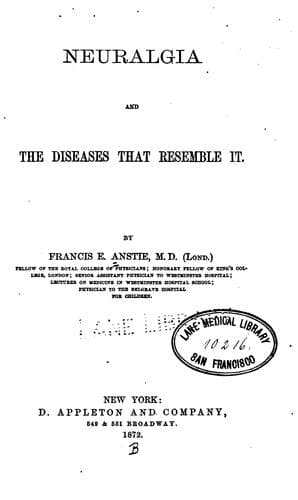
Neuralgia and the diseases that resemble itAnstie, Francis Edmund
Science
Neuralgia and the diseases that resemble it
Anstie, Francis Edmund
Neuralgia
More or less numbness, in the feet and legs chiefly, in all forms of
sensibility, excepting that by which differences of temperature are
recognized.
Frequent impairment of sight or hearing, one or both.
Frequent transitory or permanent strabismus or ptosis, one or both.
No very obvious paralysis of the bladder or lower bowel.
No necessary impairment of sexual power.
No tingling or kindred phenomenon.
No marked tremulous, convulsive, or spasmodic phenomena.
No marked impairment of muscular nutrition and irritability.
No impairment of the mental faculties.
Occasional injection of the conjunctivæ, with contraction of the pupils.
The probable limitation of the distinctive phenomenon of locomotor ataxy
(the want of co-ordinating motor power) to the lower extremities.
The above description includes all the necessary facts for the
recognition of the disease, except one, namely, that the use of the
eyesight is always needed in order to prevent the patient from falling
during progression; and is usually necessary even to enable him to stand
upright without falling.
The pains of locomotor ataxy are early phenomena in most cases, and they
are usually present, more or less, throughout the course of the disease.
They are often preceded by strabismus, with or without ptosis; the
strabismus, is usually accompanied by amblyopia. It may happen, however,
that neuralgic pains are, for a considerable time, the only noticeable
phenomena; or they may be attended with a certain amount of anæsthesia.
The most frequent type of the pains is lancinating or stabbing; they are
like violent neuralgias occurring successively in various nerves;
shifting about from one to another. Sometimes it will happen that the
pain remains fixed to one particular nerve for hours together; but it
never continues long without showing the characteristic tendency to move
about. Most commonly our diagnosis is soon assisted by the occurrence of
a greater or less degree of ataxy. But, even before the setting in of
definite atactic symptoms, the shifting character of the pains, and the
development of a very noticeable amount of anæsthesia, together with the
absence of anything like positive motor paralysis, will have given us
the necessary clew.
The effect of treatment, or rather its want of effect, usually affords
powerful assistance in distinguishing the pains of locomotor ataxy from
those of true neuralgia. Even where the pain has been fixed for some
hours in a single nerve, and has been stopped by some powerful remedy
(such as hypodermic morphia), it will be apt speedily to recur, and
frequently in some quite distant nerve.
Locomotor ataxy is a disease affecting chiefly the male sex, and
occurring in the immense majority of cases between the thirty-fifth and
the fiftieth year.
Public-domain text, read in full here on John Shaqi.
Reviews
Reviews
No reviews yet
Be the first to share your thoughts on this work.
Elsewhere in the archive
Join the Discussion
Join the discussion
Sign in to leave a comment or review.
Sign InorCreate an account