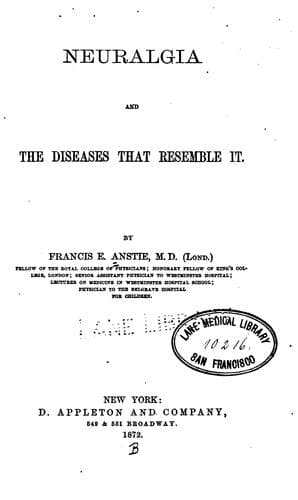
Neuralgia and the diseases that resemble itAnstie, Francis Edmund
Science
Neuralgia and the diseases that resemble it
Anstie, Francis Edmund
Neuralgia
Not merely is it strictly limited to individuals who belong to families
with neurotic tendencies, but it is itself frequently seen to occur in
several members of the same family, and sometimes of the same
generation. When, therefore, we meet with neuralgic pains of the
shifting type above described, it is very important at once to make
careful inquiries whether any members of the family have suffered from
symptoms of ataxy going on to a fatal result. Otherwise, we might be the
more readily deceived into the idea that the pains were merely
neuralgic, because the symptoms of the disease are not unfrequently
provoked by such causes as fatigue and exposure to cold or wet, which
are also very ordinary exciting causes of true neuralgia.
FOOTNOTES:
[49] The most complete and careful work of the German school, on this
subject, is the "Lehre von der Tabes dorsualis," of E. Cyon. (Berlin,
1867.)
[50] _Lancet_, June 10, 1865. (Comment on a case of Dr. J. Hughlings
Jackson's.)
[51] Radcliffe, in "Reynolds's System of Medicine," vol. ii.
CHAPTER V.
THE PAINS OF CEREBRAL ABSCESS.
Cerebral abscesses is, fortunately, a rare disease; but the very fact of
its rarity makes the resemblance of the pain it causes to that of
neuralgia the more likely to lead us into serious errors. We are apt to
forget the possibility of suppuration of the brain on account of its
infrequence.
Pain in the head is present as an early symptom of abscess in the brain
in a large proportion of cases in which there is pain at all. [Of
seventy-five cases of cerebral abscess analyzed by Gull and Sutton
(Reynolds's "System of Medicine," vol. ii.), pain was a symptom in
thirty-nine, and most frequently an early symptom.] Many cases are
recorded in which it preceded every other morbid sign by a considerable
period. It is usually more or less paroxysmal, often strikingly so; in
the latter case, it bears a great similarity to neuralgia. On the other
hand, it sometimes takes the shape of a fixed burning sensation, much
less resembling neuralgia. The situation of the pain by no means always,
nor even usually, corresponds to the situation of the cerebral abscess;
on the contrary, abscess in the cerebellum has often caused pain
referred to the anterior part of the head, and so on. So long as the
disease remains characterized only by pain, more or less, of a
paroxysmal character, the diagnosis must be very uncertain; but in the
great majority of cases certain more distinctive symptoms soon become
superadded; either convulsions (sometimes hemiplegic), vertigo, coma,
paralysis, vomiting, or a combination of some of these.
In the stage in which there is as yet no conspicuous symptom but severe
pain, the diagnosis of cerebral abscess from neuralgia must rest on the
following points of contrast:
_Cerebral Abscess._ _Neuralgia of Head._
Public-domain text, read in full here on John Shaqi.
Reviews
Reviews
No reviews yet
Be the first to share your thoughts on this work.
Elsewhere in the archive
Join the Discussion
Join the discussion
Sign in to leave a comment or review.
Sign InorCreate an account