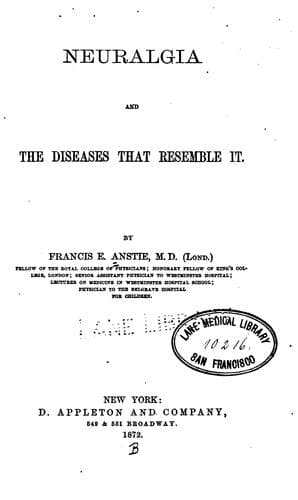
Neuralgia and the diseases that resemble itAnstie, Francis Edmund
Science
Neuralgia and the diseases that resemble it
Anstie, Francis Edmund
Neuralgia
Lead-poison sometimes enters the system continuously, for a long period,
but in proportions too minute to produce the effects which we identify
as an attack of lead-colic. I believe that for the production of the
latter complaint it is necessary that the poisoning shall be
sufficiently intense completely to paralyze a considerable piece of
bowel, thus altogether hindering peristalsis, or, rather, making the
peristaltic acts of the non-paralyzed portions above worse than
fruitless. But there is a minor degree in which it may happen that the
local affection (owing, I believe, to a less extensive deposit of lead
in the bowel) does not reach the decidedly paralytic stage; the state
then is one of irregular and painful spasm of individual fibres (quite
possibly intermingled with paralysis of a few others), and the practical
result is irregularity of evacuation--now diarrhoea, and again
constipation--and the frequent recurrence of twinges of pain that are
easily mistaken for abdominal neuralgia. Such symptoms as these are
nearly always found to have occurred, if proper inquiry be made, in
those examples of chronic lead-poisoning in which the toxic process goes
on to the development of epilepsy, or marked symmetrical paralysis of
the wrist-extensors, without the patient having ever suffered an attack
of ordinary colic. In these slow and insidious cases the constitutional
affection may not have reached the height at which the complexion and
general aspect of the patient suggests metallic poisoning: and the case
may present very neuralgia-like features. The absence of the _points
douloureux_ is not, as we have seen, conclusive against neuralgia in its
early stages. It is therefore an excellent rule, in all cases of chronic
recurrent spasmodic pain in the abdomen, especially in men, to
investigate the possibilities of lead-poisoning; and, if the slightest
suspicious appearance of the gums be found, this track of inquiry must
be followed up exhaustively before we abandon the idea. The absence of
all special neurotic history in a patient's family should increase our
suspicions respecting pains of this character that continue with an
obstinacy which makes it unlikely they are due to improper food.
Public-domain text, read in full here on John Shaqi.
Reviews
Reviews
No reviews yet
Be the first to share your thoughts on this work.
Elsewhere in the archive
Join the Discussion
Join the discussion
Sign in to leave a comment or review.
Sign InorCreate an account