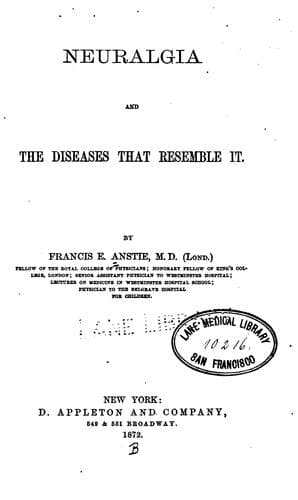
Neuralgia and the diseases that resemble itAnstie, Francis Edmund
Science
Neuralgia and the diseases that resemble it
Anstie, Francis Edmund
Neuralgia
Pains of abdominal irritation are, however, without doubt produced in
some cases by unsuspected faults of diet, and may even recur in such a
quasi-periodic manner as to strongly suggest the idea of neuralgia in
the lumbo-abdominal nerve. One special variety of this happens, I
believe, much more often than is thought. A patient will habitually take
considerable quantities of some article of food which he does not
readily digest, but which is not at all acutely irritant: under these
circumstances a simple accumulation is apt to take place in the colon,
especially at the top of the ascending colon, the top of the descending
colon, or just above the sigmoid flexure, or else in the cæcum. The
result of accumulation in the last of these places is not unfrequently
typhlitis and perityphlitis, this part of the bowel having (for some
reason) a special tendency to inflammation. Deposits in the other
localities named are rarely the cause of inflammation, but they very
frequently give rise to violent pain, which is exceedingly apt to be
taken for the pain either of gall-stone, of renal calculus, or else of
some abdominal neuralgia. In cases, therefore, where there is any
possibility that accumulation is the cause of pain, it is highly
desirable to commence with a dose of castor-oil and laudanum, followed
up, if needful, by the administration of a large warm-water enema, given
through an O'Beirne's tube. The most violent and recurrent attacks of
pain in the renal region, the flank, the abdomen, or the groin, will
sometimes be instantly cured by such means, sufficiently proving the
non-neuralgic character of the complaint.
I have elsewhere explained that the impaction of a renal or an hepatic
calculus, in the ureter or the ductus choledochus, may set up a true
neuralgia in persons with the requisite congenital predisposition. The
passage of renal or hepatic calculi may give rise to symptoms falsely
suggesting neuralgia, which require just to be mentioned here. But there
is no need to dwell much upon the diagnosis, for the passage of renal or
hepatic calculi has always attendant symptoms and features of
constitutional history, which ought to preserve the physician from
mistake. The sensation of constriction, of nausea and vomiting, the
faintness approaching to collapse, the persistent and constantly
increasing severity of the pain up to the moment at which mechanical
relief occurs, to say nothing of other phenomena, are distinctive to the
skilled observer, and, when taken in conjunction with the history of
past attacks, if any, will always prevent mistakes. In the few cases
which might still be doubtful it will be well to try the effect of a
relaxing dose of chloroform, which, in the case of calculus, will often
put an end to the paroxysm at once and finally.
CHAPTER XI.
DYSPEPTIC HEADACHE.
Public-domain text, read in full here on John Shaqi.
Reviews
Reviews
No reviews yet
Be the first to share your thoughts on this work.
Elsewhere in the archive
Join the Discussion
Join the discussion
Sign in to leave a comment or review.
Sign InorCreate an account