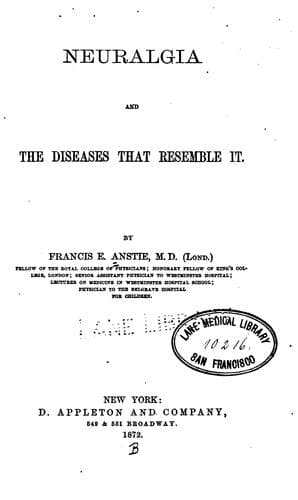
Neuralgia and the diseases that resemble itAnstie, Francis Edmund
Science
Neuralgia and the diseases that resemble it
Anstie, Francis Edmund
Neuralgia
A final word or two must be given to the distinction between neuralgia
of the head and an affection so utterly different that it is surprising
that they should be so frequently confounded. One constantly hears
medical men speak of "sick headache" (migraine) as if it were the same
thing as headache from indigestion; and, unfortunately, they often treat
migraine upon this confused and erroneous notion, doing no little
mischief thereby.
But, although migraine, already amply described, is entirely independent
of the state of digestion, and its stomach-phenomena are purely
secondary to the affection of the fifth nerve, there is a kind of
headache really dependent on imperfect digestion. The sufferers from
these headaches are dyspeptics whose stomach troubles are the result of
chronic gastric catarrhal inflammation. (In the acute form of gastric
catarrh there are even more severe headaches; but the general symptoms
of the disorder are too marked to allow us to mistake the case for
neuralgia complicated with secondary stomach disturbance.) The patients
in question have frequently passed so gradually into the dyspeptic
condition as to have become accustomed to it, and inclined to forget
that the stomach was the organ which first gave them annoyance. The
headaches, which occur from time to time, are either frontal or (more
frequently) occipital in position, and they are usually quite evenly
bilateral; still, there is not enough uniformity of difference between
them and true migraine, in this respect, to enable us to establish a
decided diagnosis upon it. This much may be said, however: that the pain
is rarely or never seated in one parietal region, as is frequently the
case with migraine and with clavus. The patient suffers very strikingly,
in almost every case, from languor and a feeling of inability to exert
himself; and has also much aching pain in the limbs, and usually a pain
(sometimes very severe) in the scapular region. The tongue may vary a
good deal in appearance, especially as regards the degree of general
redness; but it always has enlarged papillæ, most prominent toward the
tip, and more or less thick furring at the back, and reaching forward,
in some cases, nearly to the tip, to which the "strawberry" aspect is
then confined. The headache is frequently joined with nausea, but never
with absolute vomiting, unless the stomach has been provoked with a meal
that gives it more trouble than usual. The desponding frame of mind
which this kind of dyspeptics always exhibit distinguishes them, in most
cases, quite sufficiently (together with the unwholesome complexion, the
appearance of the tongue, and the great complaints of general malaise
and aching and feebleness of the limbs) from the victims of migraine,
who are often persons of bright spirits and lively intelligence in the
intervals of their attacks; but, above all, there is nothing of the
regular and characteristic sequence of events which distinguishes the
attacks of migraine.
Public-domain text, read in full here on John Shaqi.
Reviews
Reviews
No reviews yet
Be the first to share your thoughts on this work.
Elsewhere in the archive
Join the Discussion
Join the discussion
Sign in to leave a comment or review.
Sign InorCreate an account