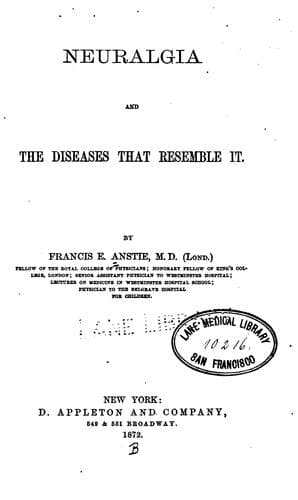
Neuralgia and the diseases that resemble itAnstie, Francis Edmund
Science
Neuralgia and the diseases that resemble it
Anstie, Francis Edmund
Neuralgia
The leading fallacy in the common view is the confusion which is
perpetually being made between function and action. Now, the function of
individual nerves is very nearly a constant quantity, at least, it
varies only within narrow limits; while the action of the same nerves
may be almost any thing. The function of the nerve is that kind of work
for which it is fit when its molecular structure is healthy; it is the
series of dynamic reactions which are necessarily produced in
nerve-tissue by the external influences which surround and impinge upon
it in the conditions of ordinary existence. The action of nerves, under
the pressure of extraordinary influences, may include all manner of
vagaries which really have nothing in common with the effects of
ordinary functional stimulation; which are, in fact, nothing but
perturbation. No one can suppose, for instance, that the explosive
disturbances of nerve-force which give rise to the convulsions of
tetanus are any mere exaggerated degree of the orderly and symmetrical
action by which the healthy nerve responds to the stimulus of volition
ordering a given set of muscles to contract; they are something quite
different in kind. And so it is with the sensory nerves. The functions
of these conductors, in health, is to convey to the perceptive centres
the sensations, varying only within a most limited range, which
correspond to a state of well-being of the organs, and which excite only
those reflex actions that are necessary to life. Thus the large surface
of sensitive nerve terminals which is represented by the collective
peripheral branches of the fifth cranial conveys to the medulla
oblongata an impression, derived from the temperature and movement of
the surrounding air, when the latter is neither too hot nor too cold,
which imparts to the brain a perception of comfortable sensations, and
excites in return the reflex action of breathing, which is necessary to
life. But the impression produced on this same peripheral expanse of
nerve-branches by prolonged exposure to cold wind may, and often does,
convey to the centres sensations which are quite different and provokes
reflex movements which are altogether abnormal. Pain is the product in
one direction; sneezing, perhaps, in the other. It seems absurd to say
that sneezing is any part of the function of those motor nerves whose
action regulates the performance of expiration. And it appears to me not
less absurd to say that pain is the function of the sensitive fibres of
the trigeminus. But the best way, perhaps, to illustrate the looseness
and incorrectness of applying the term "hyperæsthesia" (implying exalted
function) to the state of sensitive nerves when suffering pain, is to
examine the condition of distinctive perception in the very same parts
to which the painful nerves are distributed. It will invariably be
found, as we shall have occasion to see more fully proved hereafter,
that, in parts which are acutely painful, a marked bluntness of the
Public-domain text, read in full here on John Shaqi.
Reviews
Reviews
No reviews yet
Be the first to share your thoughts on this work.
Join the Discussion
Join the discussion
Sign in to leave a comment or review.
Sign InorCreate an account