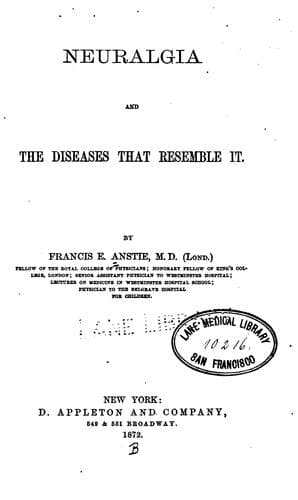
Neuralgia and the diseases that resemble it — John Shaqi
Neuralgia and the diseases that resemble itAnstie, Francis Edmund
Science
Neuralgia and the diseases that resemble it
Anstie, Francis Edmund
Neuralgia
If we inquire a little further into the circumstances under which
various kinds of pain occur, we gain some fresh suggestions. Among the
neuralgias, those are the most acutely agonizing which occur under
circumstances of impaired nutrition incident to the period of bodily
decay, and strong reasons will be hereafter adduced for the belief that
there is especial impairment of the nutrition of the central end of the
painful nerves. To find a parallel to the severity of this kind of pains
we must turn to the case of organic tumors, which, from their position,
structure, and mode of growth, necessarily exercise continuous and
severe pressure on the branches or the trunk of a nerve; or to the class
of pains which attend severe cramp, or tonic contraction of muscles.
Now, it can scarcely be doubted that in the latter instance there is an
abnormally rapid and violent destruction of tissue going on; at the very
least there is an extraordinarily violent and irregular manifestation of
motor force. In any case the patent fact here is dynamic perturbation
of a severe kind; and, in the instance of organic tumors exercising
steady and continuously increasing pressure on nerves, one can scarcely
doubt that a similar perturbation, less intense but more enduring, is
necessarily set up. That which can be done in the way of producing
severe pain by these severe affections of the peripheral portions of
nerves, or of tissues lying outside them, we might _a priori_ expect
would be effected by slighter but continuous changes in the nutrition of
the more important portion of the nerve itself--its central gray
nucleus. One would say that a pathological process which continuously
and progressively lowered the standard of nutrition here must interfere
from hour to hour, certainly from day to day, with that regular and
equable distribution of force which is the essence of unimpeded
function.
Take, again, the case of the very severe pain which frequently attends
inflammation of the pleura and of the peritoneum. Whatever theory of the
causation of these pains we may adopt, it is certain that one most
important element in their production and maintenance is the continual
movement and friction of the affected parts. But there is little doubt
that the moving muscles are involved in the inflammatory process, as Dr.
Inman has correctly observed. It would seem plain that under these
circumstances--an inflamed muscular structure forced to perform its
ordinary contractions as well as it can--there must be powerful dynamic
perturbation going on.
Public-domain text, read in full here on John Shaqi.
Reviews
Reviews
No reviews yet
Be the first to share your thoughts on this work.
Join the Discussion
Join the discussion
Sign in to leave a comment or review.
Sign InorCreate an account