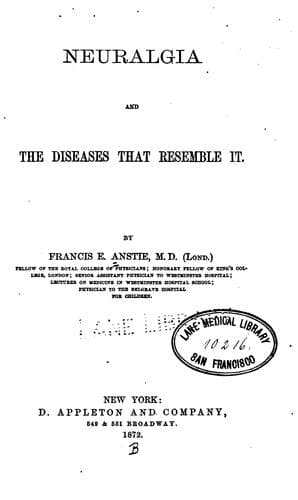
Neuralgia and the diseases that resemble itAnstie, Francis Edmund
Science
Neuralgia and the diseases that resemble it
Anstie, Francis Edmund
Neuralgia
There is doubtless some force in these objections, especially in the
second, for it does seem rather inconvenient to call by the same name so
deadly a disorder as the worst form of angina, and so comparatively
harmless a malady as some of those instances of chronic tendency to
spasmodic pain of the heart which are not very uncommon, and in which
the patient survives, perhaps, to an old age. Yet, after all, there is
the greatest difficulty in drawing any rational line of distinction; for
the basis of the affection seems the same in every case, whether pain or
spasm be the predominant feature, and whether the course of the disease
be long or short. All that appears to be necessary for its production is
a certain originally neurotic temperament (with possibly some congenital
weakness or some post-natal disease of that part of the spinal-cord
centres which Von Bezold has described as furnishing three-fourths of
the propulsive power of the heart) and the presence of almost any kind
of difficulty or embarrassment of the action of the heart. The most
common source of this embarrassment is perhaps failure of nutrition in
the muscular walls of the heart, from disease of the coronary arteries.
Indeed, it is not known that any organic change of the heart or great
vessels, even of the slightest kind, is necessary to the production of
angina; on the contrary, there is every reason to think that mere
fatigue and depression may bring on the attacks in persons of a strongly
nervous temperament. For my own part, I am inclined to believe, however
that there really always is disease somewhere in the cardiac centre of
the spinal cord, though that disease may consist in no more than a
disposition to minute interstitial atrophy. But we shall say more about
this presently.
It is at any rate certain that cardiac neuralgia is always a most grave
complaint, from the almost total uncertainty whether succeeding attacks
will not involve a fatal amount of spasm. As for the expression angina
pectoris, it is just one of those mischievous terms which, arising out
of the mystified ignorance in which the elder physicians found
themselves as to the pathology of internal diseases, have since been
attached in turn to various definite organic changes, with none of which
they had any essential connection; and it is therefore much to be wished
that it could be altogether done away with. At the same time, there is
so much that is peculiar in the case of cardiac neuralgia, owing to the
importance of the organ affected, that it will be necessary here to
treat not merely its symptoms, but also its diagnosis, prognosis,
etiology, pathology, and treatment, in a separate and continuous manner.
Public-domain text, read in full here on John Shaqi.
Reviews
Reviews
No reviews yet
Be the first to share your thoughts on this work.
Elsewhere in the archive
Join the Discussion
Join the discussion
Sign in to leave a comment or review.
Sign InorCreate an account