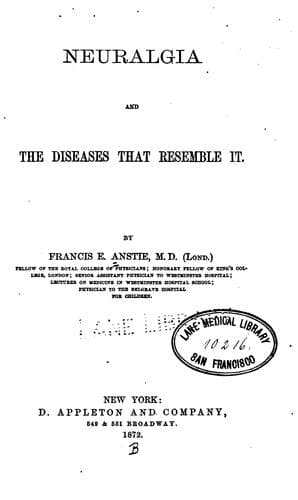
Neuralgia and the diseases that resemble itAnstie, Francis Edmund
Science
Neuralgia and the diseases that resemble it
Anstie, Francis Edmund
Neuralgia
_Clinical History and Symptoms._--Cardiac neuralgia usually shows itself
for the first time with considerable abruptness. The patient may or may
not have been consciously ill before the actual seizure, but it rarely
happens, even when the heart has notoriously been the subject of some
organic disease, that there has been any thing to lead him to expect the
kind of attack from which he now suffers. In the midst of some little
unusual effort, or even without this kind of provocation, suddenly the
patient is attacked with severe pain, usually at the lower part of the
sternum; this pain darts through to the back and left shoulder, and
nearly always runs down the left arm. Sometimes, indeed, it is felt
acutely over a large area of the chest, and runs down both arms; this is
the case in a patient now under my care, in whom the affection is more
obviously a neurosis, and less attended with coarse organic changes,
than is usually the case. Along with the pain, which is always very
distressing, but varies greatly in severity in different cases, there is
a variable amount of another sensation which can be compared to nothing
but cramp, or rather compression; the patient usually describes it as
feeling as if some one were grasping the heart in his hands, and, when
this sensation is at all prominent, the idea of impending death is most
strongly impressed on the sufferer's mind. His outward appearance seems
to confirm the idea. In cases where the sense of compression is great,
the face is of an ashen gray; the lips white, with a faint livid tinge;
the pulse small, feeble, and unrhythmical, or imperceptible, at the
wrist; cold perspiration breaks out upon the face; in short, all the
signs of approaching dissolution are present. In cases where the
suffering is chiefly or entirely confined to severe pain, of a darting
or burning character, the state of the circulation is often different.
The heart bounds against the ribs, in rapid and painful palpitation, the
face is flushed deep crimson, the pulse at the wrist is large, bounding,
but very compressible; in fact, the outward appearance of the patient is
so different from that of one who suffers from the more depressing kind
of angina, that it is difficult to consider the two affections as
essentially similar. But there can be no question, if we carefully
examine the matter, that they are mere varieties of the same disorder,
especially as they both may successively occur in the same person.
Public-domain text, read in full here on John Shaqi.
Reviews
Reviews
No reviews yet
Be the first to share your thoughts on this work.
Elsewhere in the archive
Join the Discussion
Join the discussion
Sign in to leave a comment or review.
Sign InorCreate an account