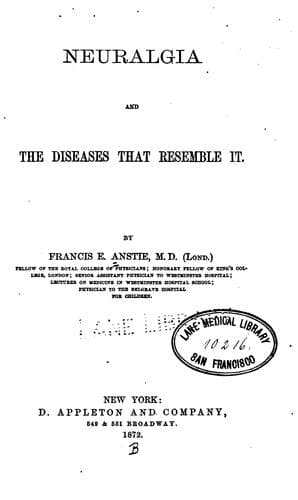
Neuralgia and the diseases that resemble itAnstie, Francis Edmund
Science
Neuralgia and the diseases that resemble it
Anstie, Francis Edmund
Neuralgia
One of the best examples I ever saw of cardiac neuralgia (ultimately
proving fatal) was one of which the origin was entirely nervous. It
occurred in a gentleman in the prime of life, and naturally of a
powerful physique, whose very active and capacious mind had been greatly
overwrought. The whole weight of responsibility for an undertaking of
national importance, and which involved great difficulties and much
anxiety, for a long time rested on his shoulders. Under these influences
he broke down, and never effectually recovered himself. At first, the
symptoms were those of mere ordinary nervous exhaustion, but after a
time he became subject to frequently recurring attacks of agonizing
spasmodic heart-pain, with a sense of impending dissolution; from these
he was invariably relieved by the inhalation of a small amount of
chloroform. Not the slightest organic heart mischief could be detected,
either during life or after death.
_Pathology._--Angina stands in so peculiar a position that I deem it
well to discuss it as a whole, and not merely its clinical history, in
this place. As I have already said, there is nothing in the morbid
appearances found after death which is characteristic of fatal angina,
and in the milder kinds of cardiac neuralgia we are driven back upon the
general probabilities which we deal with in reasoning as to the origin
of neuralgias in general. As to morbid changes, it is impossible to say
any thing more exhaustive of the facts known than the following words of
Dr. Walshe:[9] "First, there are few, if any, structural diseases either
of the heart, its orifices, and its nutrient arteries, or of the aorta,
found recorded in the narratives of the post-mortem examination of
different victims of angina pectoris. Secondly, there is no conceivable
disease of these structures and parts which has not in various
individuals reached the highest point of development, without anginal
paroxysms, even of a slight kind, having occurred during life; to this
proposition extensive calcification of the coronary arteries perhaps
furnishes a solitary exception. Thirdly, the organic changes most
frequently met with have been fatty atrophy and flabby dilatation of the
heart; obstructive disease of the coronary arteries by atheroma and
calcification of the orifice and arch of the aorta. Fourthly, the rarest
have been hypertrophy and hypertrophy with dilatation. In truth, it may
be doubted whether these conditions in their genuine form, without any
combination of fatty atrophy, have ever been the sole morbid states
present." From all this Dr. Walshe concludes that the fundamental
mischief of angina is neurotic; and, while he believes that some
textural change in the heart is necessary as an irritant to generate
this neurotic susceptibility to dynamic disturbance from slight causes,
he recognizes only one common quality in these various cardiac lesions,
viz., that they indicate mal-nutrition and weakened power. Dr. Walshe
Public-domain text, read in full here on John Shaqi.
Reviews
Reviews
No reviews yet
Be the first to share your thoughts on this work.
Elsewhere in the archive
Join the Discussion
Join the discussion
Sign in to leave a comment or review.
Sign InorCreate an account