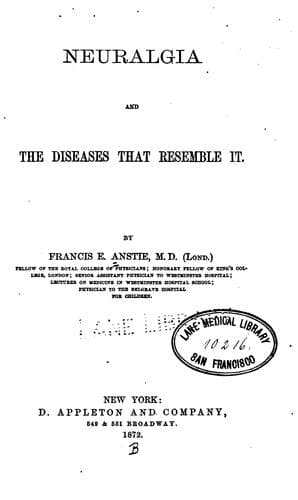
Neuralgia and the diseases that resemble itAnstie, Francis Edmund
Science
Neuralgia and the diseases that resemble it
Anstie, Francis Edmund
Neuralgia
Of the purely neurotic variety of angina it is impossible to determine
the frequency; but it seems certain that the affection is common, and I
suspect that it occurs more often than is supposed, as a sequel to
asthma. The probable relationship between the two affections was long
ago indicated by Kneeland.[8] I have certainly seen several cases of
asthma in which spasmodic pain of the heart has occurred on various
occasions after or during a very severe asthmatic paroxysm. One case was
that of a gentleman, of a highly delicate and neurotic temperament, who
had suffered for fifteen or sixteen years from well-marked spasmodic
asthma: this case is remarkable as an illustration of several points
which will be dwelt upon in other parts of this volume. For some time
before the outbreak of cardiac neuralgia, he had suffered repeatedly
from severe facial neuralgia, and these attacks on more than one
occasion culminated in facial erysipelas, or what was entirely
indistinguishable from that affection. He then began to suffer from
cardiac pain and spasm after his asthmatic paroxysms, and these new
symptoms speedily assumed the form of a very severe intermittent angina:
in several of the attacks he appeared about to die. The pain in these
attacks is very severe; it occupies a large area in the centre of the
chest, and runs down both arms; and, what is strange, the arms become
remarkably swollen and hot after an unusually long bout of pain, I
presume from vaso-motor paralysis. At present (nearly five years from
the commencement of the cardiac neuralgia) the cardiac attacks, though
of frequent occurrence, are decidedly more tolerable than they were at
first, and the sense of squeezing or pressure, though never quite
absent, does not amount to the dreadful sort of feeling which used to
convince the patient that he was at the point of death. In this case,
the heart has been repeatedly explored without any positive result, and
the pulse has been frequently tested by the sphygmograph. The latter
instrument is the only mode of examining by which I have been able to
elicit even suspicious evidence that there is any organic change of the
heart; by means of it I have lately obtained some grounds for suspecting
that there is slight dilatation of the heart, but it is uncertain
whether anything of the kind existed at the commencement of the anginal
symptoms. In this case I am inclined, on the whole, to doubt whether the
angina will ever prove fatal, unless the bronchitis, with which the
patient's asthma has for some time past been liable to be complicated,
should occur in a severe form; in that case it is likely that the
additional embarrassment of the heart's action may bring on fatal
spasms.
Public-domain text, read in full here on John Shaqi.
Reviews
Reviews
No reviews yet
Be the first to share your thoughts on this work.
Elsewhere in the archive
Join the Discussion
Join the discussion
Sign in to leave a comment or review.
Sign InorCreate an account