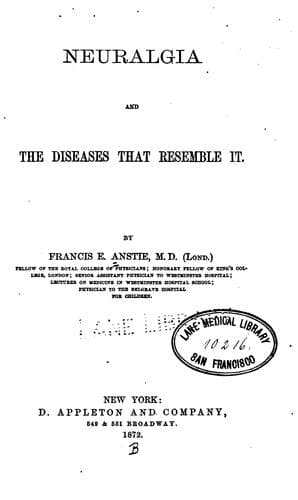
Neuralgia and the diseases that resemble itAnstie, Francis Edmund
Science
Neuralgia and the diseases that resemble it
Anstie, Francis Edmund
Neuralgia
Of predisposing causes, the majority are the same as those of which we
have spoken in our general remarks on the etiology of neuralgia. A
family history of a tendency to the graver neuroses is I believe
universal, and, indeed, direct inheritance of angina from father to
son, as in Arnold's case, has happened in many recorded instances. A
very remarkable fact is the time of life at which the disease originally
appears: Walshe says it is rare before the age of fifty, but excessively
rare before forty. This is very interesting, as placing angina in the
same category with the severe and intractable forms of facial and other
neuralgias which are so highly characteristic of the period of bodily
degeneration. One may even gather a suspicion, though it goes but a
short way toward proof, that the essence of angina is an atrophy either
of the cardiac plexus or of the nucleus of the vagus, or of that part of
the spinal cord, already mentioned, which seems to be the centre of the
major part of the propulsive force of the heart.
On the other hand, there is a fact, even more remarkable than the
influence of age, which tells somewhat in a contrary direction. There is
a most extraordinary preponderance of males among the victims of angina.
Sir John Forbes found eighty males among eighty-eight patients suffering
from this disease. On the first blush it would seem natural, indeed
almost necessary, to explain this by supposing that, as men take a much
larger amount of strong physical exercise than women, they will furnish
a much larger proportion of subjects in whom an ill-nourished heart will
break down under its work and be seized either with paralysis or cramp
(for the two states are, after all, not opposed to each other, but only
varying shades of debility.) Upon this theory one would have to believe
that the origin of angina was far more peripheral than central, if we
are to suppose that spasm is the ordinary condition of the heart during
the anginal paroxysm. But we do not know that this is the case; indeed,
there are many arguments against it; and at any rate we must suppose
that in a considerable number of cases the muscular state is one of
relaxation from want of power. And certainly it is infinitely more
probable that paralysis or spasm of a muscular viscus should occur as a
reflex consequence of neuralgia occurring in a nerve whose central
nucleus was closely connected with the motor centre of the organ, than
that mere paralysis of the viscus should convey a reflex impression to
sensitive nerves which should express itself in the form of acute pain.
It must be confessed that the matter hangs in doubt; but the evidence
is, on the whole, very strong for the belief that central nervous
mischief is the most important element in angina.
Public-domain text, read in full here on John Shaqi.
Reviews
Reviews
No reviews yet
Be the first to share your thoughts on this work.
Elsewhere in the archive
Join the Discussion
Join the discussion
Sign in to leave a comment or review.
Sign InorCreate an account