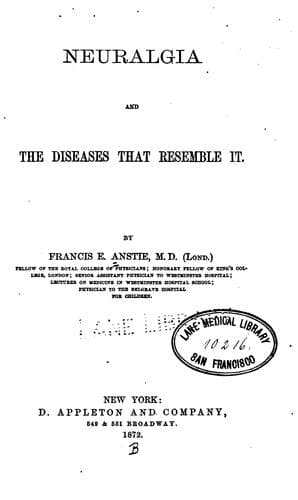
Neuralgia and the diseases that resemble itAnstie, Francis Edmund
Science
Neuralgia and the diseases that resemble it
Anstie, Francis Edmund
Neuralgia
Another very important class of predisposing causes of angina is the
mental emotions. It is notorious that the disease is one not common in
humble life; it chiefly assails the more cultivated class, and
especially men who are much engaged in affairs in which great mental
anxiety or emotion is mingled with severe toil of intellect. Thus the
professional class has always shown a sad predominance in tendency to
this disease; a large number of the victims have been found among
overworked clergymen, lawyers, doctors, engineers, etc. The various
forms of heart-lesion which have been already mentioned must doubtless
be considered highly predisposing, when there is already a neurotic
susceptibility, more especially those which, like fatty degeneration of
the muscular structure, greatly enfeeble the heart's action. I do not
believe that these diseases will cause angina in a person who is free
from the peculiar nervous susceptibility.
The immediately exciting causes are very various. The most common of all
is doubtless some exertion of body, or distress of mind, which at once
agitates and embarrasses the heart's action; and, where the tendency to
cardiac neuralgia has once declared itself by an actual attack, very
slight excesses of this kind will usually suffice to re-excite the
paroxysm. Sexual excitement is particularly provocative of the attacks,
in the predisposed. But much slighter causes suffice, in those cases
where the irritability of the cardiac nerves has become very intense:
thus a mere puff of cold air upon the face, and other similar slight
peripheral impressions, by acting in a reflex manner, have frequently
produced the paroxysm. I have seen an extremely severe anginal attack
brought on by the slight shock of the sudden slamming of a door. And it
would even appear that some peripheral excitements of a powerful kind
may operate with such force as to generate angina in persons who are
merely in weak health, but who cannot be supposed to be specially
predisposed to angina; it is in this way, I presume, that we must
explain the extraordinary occurrence, reported by Guelineau,[10] of an
epidemic outbreak of angina, in which numbers of men, belonging to a
ship's crew, were simultaneously affected. The men had been badly fed,
and their quarters were very unhealthy; but the powerful exciting cause
seemed to be the rapid change from a very hot to a very cold climate.
Not only were there many cases of severe angina, but other forms of
neuralgia, and severe colics, were observed in others of the crew. Among
the sources of peripheral irritation which ought to be particularly
considered, in relation to angina, are the diseases and injuries which
produce powerful irritation of the branches of the trigeminus. Lederer's
cases[11] of violent vomiting and cardiac pain, from the operation of
pivoting teeth, and Remak's instances[12] of violent palpitation and
cardiac distress, produced by disease of the last molar tooth, seem to
Public-domain text, read in full here on John Shaqi.
Reviews
Reviews
No reviews yet
Be the first to share your thoughts on this work.
Elsewhere in the archive
Join the Discussion
Join the discussion
Sign in to leave a comment or review.
Sign InorCreate an account