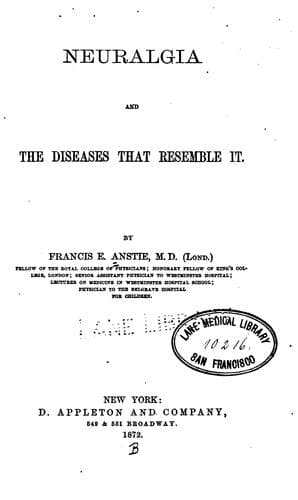
Neuralgia and the diseases that resemble itAnstie, Francis Edmund
Science
Neuralgia and the diseases that resemble it
Anstie, Francis Edmund
Neuralgia
8. Pain running round one side,
but not extending to shoulder
or arm.
It is scarcely necessary to say that no single one of the above signs is
individually of positive worth for the decision, which must be made
after a careful review of the comparative arguments, _pro_ and _con_.
The disorders with which angina is most likely to be confused are (1)
Myalgia of the intercostal or pectoral muscles; (2) intercostal
neuralgia; (3) acute commencing pleurisy. Either of these may very
perfectly simulate the more formidable disease, as regards the two
elements of acute pain and catching of the breath; but the condition of
the circulation, taken together with the consideration of the above
named points, will generally decide the question. Especially important
is the deep persuasion of impending dissolution, when present, as a
positively affirmative symptom.
It should be born in mind that, if we are summoned to a patient's
assistance, and have no previous history to guide us, our diagnosis, to
be useful, must be rapid; and it is always better to err on the side of
angina than in other directions, and to employ remedies boldly in that
sense, if there be any reasonable ground for believing the case to be of
that nature. A more mature and careful diagnosis may be made when the
patient has recovered from the severe symptoms of the paroxysm.
_Prognosis._--The prognosis of cardiac neuralgia is at best doubtful,
and, in many cases, positively bad in the highest degree. If the attacks
occur for the first time in a patient who has passed middle life, and is
physiologically old for his age, _i. e._, shows tendency to degenerative
changes of vessels, arcus senilis, gray hair etc., they are of very
gloomy import; more especially if any signs exist which make a fatty
change in the ventricle probable, or if there be serious valvular
lesions. The probability here is greatly in favor of a speedy fatal
termination; if the first attack does not kill, a second or third very
probably will; at any rate, the patient is not likely to survive any
considerable number. If the attack occurs in a younger person, in whom
there is not much likelihood that arterial degeneration has seriously
commenced, or the heart-muscles become fatty, more especially if the
attacks have been brought on by such an accidental circumstance as a
very exhausting bout of mental or physical toil, then there is
considerable reason to hope that the disease may soon wear itself out.
Even patients who have serious valvular lesions may, with young and
undegenerated tissues in their favor, quiet down again into a regular
habit of semi-health, in which they may live for a long time without
any recurrence of cardiac neuralgia. The more purely neurotic form,
again, especially when it develops gradually out of some pre-existing
Public-domain text, read in full here on John Shaqi.
Reviews
Reviews
No reviews yet
Be the first to share your thoughts on this work.
Elsewhere in the archive
Join the Discussion
Join the discussion
Sign in to leave a comment or review.
Sign InorCreate an account