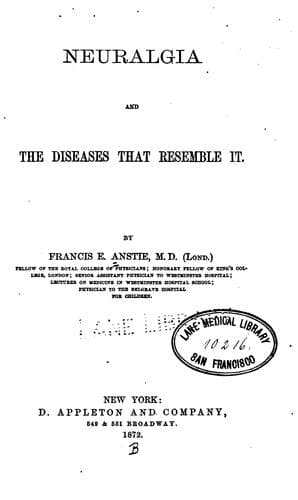
Neuralgia and the diseases that resemble itAnstie, Francis Edmund
Science
Neuralgia and the diseases that resemble it
Anstie, Francis Edmund
Neuralgia
show that, both through the vagus and the sympathetic, the most
powerful reflex action may be produced in the heart and stomach by
irritation of the fifth cranial.
Another occasional excitant of angina is an interesting link in the
chain of proof that angina is _au fond_ a neuralgia, namely, the
malarial poison, which has in a good many well-observed cases distinctly
induced the disease.[13] Finally, the occasional influence of excessive
tobacco-smoking in producing anginal attacks, in persons not affected
with any discoverable organic heart-disease, affords the strongest
corroborative evidence of the essentially neurotic character of angina
pectoris. M. Beau[14] has recorded many serious, and some fatal, cases
from this cause. Probably in both the malarial cases and those induced
by tobacco-poisoning the special neurotic tendency existed already.
_Diagnosis._--The diagnosis of angina pectoris, in those severe forms
with which the popular idea of the disease is chiefly connected, can
hardly be a matter of much difficulty. When we see an elderly man lying
in a state of deathly collapse, which has suddenly come on, with cold
sweats and nearly extinguished pulse, gasping for breath, and
complaining of intolerable pain in the chest and arm, and a sense of
oppression more dreadful, even, than the pain, we can hardly doubt that
the case is angina in its worst form. On the other hand, when a young
person, especially a young female, complains even of very severe pain in
the cardiac region, together with breathlessness, especially if the
heart be palpitating and the face flushed, the diagnosis, though not
immediately certain, already very strongly indicates the probability
that the case is not one of primary cardiac neuralgia at all. These are
extreme instances, however. In more doubtful cases, the following are
the principal materials for decision:
_Affirmative Signs._ _Negative Signs._
1. Age over forty. 1. Age under forty.
2. Male sex. 2. Female sex.
3. Nervous temperament (personal 3. Temperament either not nervous
and family) without marked at all, or markedly hysterical
hysteria or hypochondriasis. or hypochondriacal.
4. Existence of arterial 4. No signs of arterial
degeneration. degeneration.
5. Existence of valvular disease 5. No discernible valvular
of the heart. disease.
6. Extension of the pain to 6. Heart sounds clear and strong.
one or both arms.
7. Vivid sense of approaching 7. Pain fixed to one spot and
dissolution. increased or relieved by
muscular movements of the
painful parts.
Public-domain text, read in full here on John Shaqi.
Reviews
Reviews
No reviews yet
Be the first to share your thoughts on this work.
Elsewhere in the archive
Join the Discussion
Join the discussion
Sign in to leave a comment or review.
Sign InorCreate an account