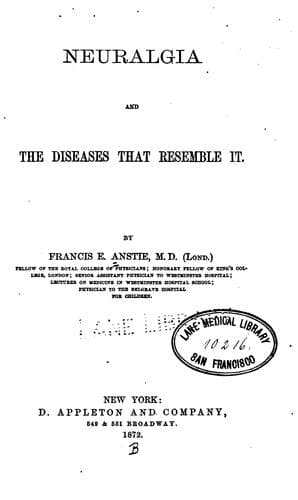
Neuralgia and the diseases that resemble itAnstie, Francis Edmund
Science
Neuralgia and the diseases that resemble it
Anstie, Francis Edmund
Neuralgia
Abdominal pneumogastric neuralgia is an extremely distressing and
occasionally a very intractable disorder. The subjects of it are almost
invariably in a state of marked and evident debility, and inquiry
generally elicits the fact that they have suffered at other times from
neuralgia elsewhere than in its present seat. By far the most common
history of previous affections of this kind is that of trigeminal
neuralgia, especially of the supra-orbital branch; and it has several
times occurred to me to observe the direct sequence of a gastralgia upon
a unilateral browache. Anæmia is a specially frequent attendant of
gastralgia, more so than of other neuralgias. Women are, by the general
consent of authors, more liable to gastralgia than men.
The special mark of true neuralgic pain in the abdominal pneumogastric,
as distinguished from other deep-seated pains in the epigastrium, is the
remarkably direct relation of its severity to the patient's exhaustion,
particularly in regard to the weakness induced by want of food. While
the great majority of dyspeptic pains are increased by filling the
stomach, gastralgia, on the contrary, is invariably relieved by food,
often most strikingly and completely. Pressure from without, also, while
it aggravates most pains dependent on local organic mischief, nearly
always more or less relieves gastralgia. Equally striking is the comfort
given by stimulants, especially by hot brandy-and-water; in this respect
gastralgia resembles colic. There is something special in the degree of
mental depression which attends gastralgic pain. In this it resembles
the pains of hypochondriasis, but there is a resilience of the spirits
when the pain has been relieved which is not seen in the latter
affection. A very frequent complication of gastralgia is severe
palpitation of the heart, but during the paroxysm itself the pulse,
whether rapid or not, is commonly small, at first tense, and afterward
soft, but not acquiring any considerable volume till the pain has
ceased.
Public-domain text, read in full here on John Shaqi.
Reviews
Reviews
No reviews yet
Be the first to share your thoughts on this work.
Elsewhere in the archive
Join the Discussion
Join the discussion
Sign in to leave a comment or review.
Sign InorCreate an account