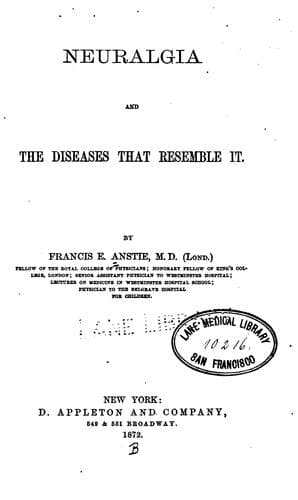
Neuralgia and the diseases that resemble itAnstie, Francis Edmund
Science
Neuralgia and the diseases that resemble it
Anstie, Francis Edmund
Neuralgia
So severe is the pain, and so complete the mental and physical
prostration in bad attacks of gastralgia, that the first aspect of the
patient might suggest--indeed often has suggested--the occurrence of
gastric or duodenal perforation; but, as soon as the paroxysm is over
all the alarming appearances vanish, leaving only a certain amount of
tenderness on deep pressure. In the more typical cases there are no
signs of dyspepsia whatever, no fulness nor excessive redness of the
tongue, no nausea, regurgitation of food, nor pyrosis. Occasionally the
neuralgic affection is complicated with more or less gastric catarrh;
but this is a much rarer occurrence, in my experience, than some writers
would lead one to believe; and, moreover, where a certain amount of
organic disorder of the stomach is observed, it is usually a mere
secondary result of the neuralgia. The most severe example of gastralgia
which I ever saw was entirely unaccompanied by dyspepsia; this patient
absolutely attempted suicide to escape from his agonizing pains, which
recurred with the greatest frequency and obstinacy, but were at last
entirely removed by strychnia. In another patient whose very interesting
case will be again alluded to under the head of Complications of
Neuralgia, violent abdominal pneumogastric pain was succeeded by a
severe attack of trigeminal neuralgia, accompanied by inflammation of
the eye, which inflicted irreparable damage; here, too, the gastralgia
was entirely uncomplicated by any other stomach-symptoms.
_Cerebral Neuralgia._--We enter, here, on an extremely obscure and
doubtful subject: Can there be pain in the central masses of the
encephalon? There are undoubtedly a not inconsiderable number of cases
of pain, neuralgic in type on the whole, in which the suffering cannot
be referred to any recognizable superficial nerve. It seems deeply
situated within the cranium. I have also quoted cases of Dr. Hillier's
in which not merely was there deep-seated headache in children, but
there was something like a characteristic general change observed in the
brain-tissues after death, viz., a great moisture and softness of
texture. Notwithstanding all this, I am not convinced, nor indeed much
disposed to believe, that pain is ever felt in the structure of the
brain; I rather believe that, in the cases where this seems to occur,
the pain is either in the intracranial portion of the nerve trunks, or,
far more probably, in the twigs of nerves that are distributed to the
cerebral membranes. In that case they are, strictly speaking, only
varieties of neuralgia of the fifth nerve, and might have been properly
discussed under that heading; but it is more convenient to speak of them
apart, since their phenomena present considerable differences from those
of the external neuralgias of the head and face.
Public-domain text, read in full here on John Shaqi.
Reviews
Reviews
No reviews yet
Be the first to share your thoughts on this work.
Elsewhere in the archive
Join the Discussion
Join the discussion
Sign in to leave a comment or review.
Sign InorCreate an account