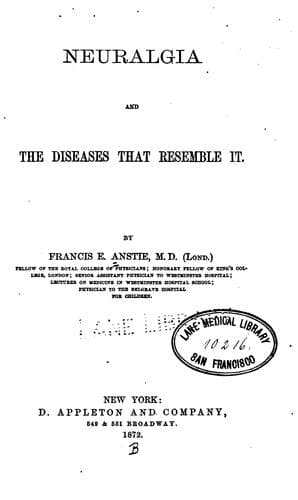
Neuralgia and the diseases that resemble itAnstie, Francis Edmund
Science
Neuralgia and the diseases that resemble it
Anstie, Francis Edmund
Neuralgia
I have now seen several of these cases of intracranial neuralgias, and
very perplexing and (at first sight) alarming they certainly are. The
first of these cases came under my care in 1868. The patient was a
single lady who had greatly over-tasked an intellect that was not,
perhaps, originally very strong, by trying to do hack literature on
conscientious principles; insisting, for instance, on knowing something
about every subject she wrote upon. Her age was thirty-eight when she
applied to me; menstruation was scanty but regular; and, on the whole,
she could not be said to have passed an unhealthy life, although
"nervous-headaches" and "sick-headaches" had occasionally beset her.
This time the trouble seemed to be more serious. Ten days before
applying to me, she had awaked in the morning with a feeling that
something was very wrong in her head; there was not so much pain as a
dull, brooding sort of weight, felt deeply within the cranium, and
rather anteriorly. This had not lasted many hours when she was seized
with a sensation of intense cold, amounting almost to rigors, and then
before long was suddenly attacked with acute splitting pain in the same
situation as the feeling of weight already mentioned had occupied. This
pain, which came and went, or rather intensified and remitted, without
ever completely ceasing, lasted about two hours, and then rather
suddenly disappeared, leaving the patient with a deep "bruised and sore
feeling in her brains." The pain recurred about the middle of the next
day, lasting for several hours, and again leaving behind it the sore
feeling. Day by day the paroxysms returned, and, on the day before her
visit to me, the patient had, she told me, been driven frantic by her
sufferings and had become actually delirious. Her appearance, when I
first saw her, was wretched; the face haggard, both eyes sunken and
surrounded with deep rings of dusky pigment, both conjunctivæ bloodshot,
the whole face almost earthy in its pallor. At that hour (11 A. M.) the
pain had not positively recommenced, but she was in momentary dread of
its recurrence. She complained of giddiness, muscæ volitantes, and great
feebleness of vision, and dreaded attempting to read, as the mere effort
of fixing her eyes on anything intently caused flashes of fire before
them. It was difficult at first to believe that there was not some
serious organic brain-mischief; but on the whole I concluded that there
was an absence of any genuine symptoms of such disease. At the same
time, the pain was decidedly not referred to any cutaneous sensory
nerve; and on the whole it appeared probable that the affection was
intracranial. There remained the diagnosis of meningeal neuralgia, and
to this I provisionally made up my mind. The opinion that the pain did
not depend on any fixed organic disease was decisively justified by the
results of treatment. One-sixth of a grain of morphia was injected on
the occasion of the first visit, and this was repeated every day, and
Public-domain text, read in full here on John Shaqi.
Reviews
Reviews
No reviews yet
Be the first to share your thoughts on this work.
Elsewhere in the archive
Join the Discussion
Join the discussion
Sign in to leave a comment or review.
Sign InorCreate an account