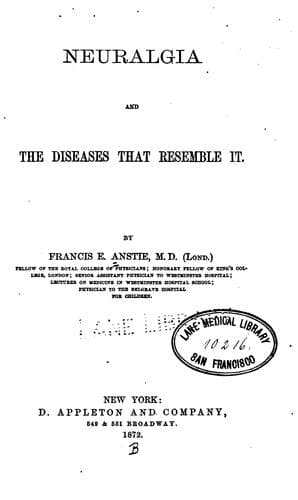
Neuralgia and the diseases that resemble itAnstie, Francis Edmund
Science
Neuralgia and the diseases that resemble it
Anstie, Francis Edmund
Neuralgia
Permanent tonic spasm, not due to photophobia, was
observed in the eyelid in four cases, in the muscles of mastication four
times, in the muscles of the external ear once. Paralysis affected the
motor oculi, causing prolapse of the upper eyelid, in six cases; in half
of these there was also outward squint. In two instances the facial
muscles were paralyzed in a purely reflex manner. The pupil was dilated
in three cases, and contracted in two others, without any impairment of
sight; in three others it was dilated, with considerable diminution of
the visual power. Finally, with regard to common sensibility, M. Notta
reports three cases in which anæsthesia was observed. Hyperæsthesia of
the surface only occurred in the latter stages of the disease.
To Notta's list of complications of trigeminal neuralgia must be added
the following, all of which have been witnessed, and several of them in
a large number of instances: Iritis, glaucoma, corneal clouding, and
even ulceration; periostitis, unilateral furring of the tongue, herpes
unilateralis, etc. In writing on this subject three or four years ago, I
mentioned that all these secondary affections had been seen by myself,
except glaucoma. That is now no longer an exception; indeed, my
attention has been so forcibly called to the connection between glaucoma
and facial neuralgia, that I shall presently examine it at some length.
The trigeminus is, of all nerves in the body, that one whose affections
are likely to cause secondary disturbances of wide extent and various
nature, owing to its large peripheral expanse, the complex nature of its
functions, and its extensive and close connections with other nerves.
Moreover, its relations to so important and noticeable an organ as the
eye tends to call our attention strongly to the phenomena that attend
its perturbations. But there is every reason to think that all secondary
complications which may attend trigeminal neuralgia are represented by
analogous secondary affections in neuralgias in all kinds of situations;
and we may classify them in the principal groups which correspond to
disturbance of large sets of functions:
Public-domain text, read in full here on John Shaqi.
Reviews
Reviews
No reviews yet
Be the first to share your thoughts on this work.
Elsewhere in the archive
Join the Discussion
Join the discussion
Sign in to leave a comment or review.
Sign InorCreate an account