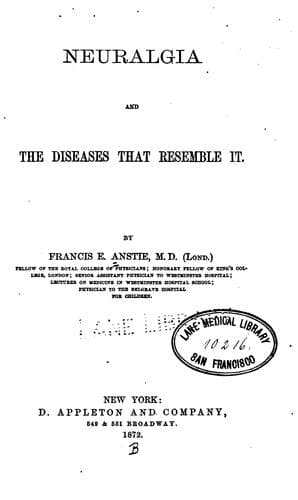
Neuralgia and the diseases that resemble itAnstie, Francis Edmund
Science
Neuralgia and the diseases that resemble it
Anstie, Francis Edmund
Neuralgia
1. First, and on the whole, probably, the most common of all secondary
affections, we may rank some degree of vaso-motor paralysis. It may be
doubted if neuralgia ever reaches more than a very slight degree without
involving more or less of this; for so-called points douloureux are
themselves pretty certainly, for the most part, a phenomenon of
vaso-motor palsy; and the more widely-diffused soreness, such as remains
in the scalp, for instance, after attacks of pain, even at an earlier
stage of trigeminal neuralgia than that in which permanently tender
points are formed, is probably entirely due to a temporary
skin-congestion. The phenomenon presents itself in a much more striking
way in the condition of the conjunctiva seen in intense attacks of
neuralgia affecting the ocular and peri-ocular branches of the fifth;
one sometimes finds the whole conjunctiva deeply crimson; and, in one
remarkable instance that I observed, the same shade of intense red
colored the mucous membrane of the nostril of the same side. In several
instances, I have seen a more than usually violent attack of sciatic
pain followed by the development of a pale, rosy blush over the thinner
parts of the skin of the leg, especially of the calf, which were then
extremely tender, in a diffuse manner, for some time after spontaneous
pain had ceased.
2. Not merely the circulation, however, but the nutrition of tissues,
becomes positively affected, in a considerable number of cases. It is
difficult to judge, with any exactness, in what proportion of neuralgic
cases this occurs, but its slighter degrees must be very common. It has
very frequently happened to me, quite accidentally, in examining with
some care the fixed painful points, which are so important in diagnosis,
to be struck with the decided evidence to the finger of solid
thickening, evidently dependent on hypertrophic development of
tissue-elements; in severe and long-standing cases, I believe this
condition will always be found. Probably the change is, more usually
than not, sub-inflammatory; but it is certain, on the other hand, that
there are great variations in the kind of tissue-changes complicating
neuralgia, and that inflammation is no necessary element in them. This
subject has greatly engaged my attention, and I find myself able to give
what is probably a fuller account of the matter than any yet published
connectedly.
The following tissues have been seen by myself to become altered under
the influence of neuralgia in nerves distributed to them, or to the
parts in their immediate neighborhood.
Public-domain text, read in full here on John Shaqi.
Reviews
Reviews
No reviews yet
Be the first to share your thoughts on this work.
Elsewhere in the archive
Join the Discussion
Join the discussion
Sign in to leave a comment or review.
Sign InorCreate an account