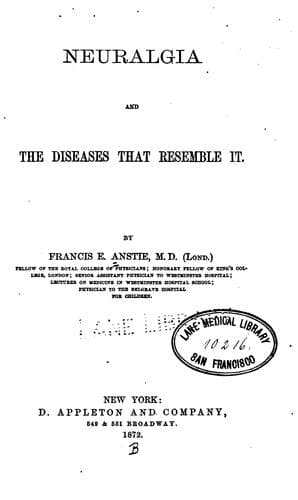
Neuralgia and the diseases that resemble itAnstie, Francis Edmund
Science
Neuralgia and the diseases that resemble it
Anstie, Francis Edmund
Neuralgia
(_e_) We come now to a group of complications of neuralgia which are
exceedingly important, and by no means adequately appreciated as yet,
viz., the acute inflammations which directly result from neuralgic
affections in a certain percentage of cases, probably much larger than
has been at all generally suspected.
The most familiar of the inflammatory complications of neuralgia is
herpes zoster, the favorite seat of which is the skin which covers one
or more of the intercostal spaces: the eruption, as occurring in this
situation, is so well known that it would be waste of time to describe
it. In young subjects zoster is commonly painless, at least the
sensations are those of heat, pricking, and irritation, rather than of
acute pain; but from puberty onward there is an increasing tendency,
especially in those otherwise predisposed to neuralgia, for zoster to be
preceded, accompanied, or followed by neuralgia of the intercostal
nerves corresponding to the distribution of the eruption. Most commonly,
the eruptive period is, in my experience, nearly or quite free from
neuralgia, but it often recurs, or breaks out for the first time, when
the vesicles are drying up, but more especially if, as is sometimes the
case, especially in elderly people, the scabs fall off and leave
superficial ulcers. Neuralgia may last, after herpes zoster, for any
time from a few days to many weeks, and I have known it so agonizingly
severe and so persistent as actually to kill an aged woman from sheer
exhaustion. In spite of sundry objections that have been raised to the
theory of the nervous origin of zoster, it appears to me that the
evidence in favor of it is overwhelming, more especially now that it is
proved that the disease, with all the same characteristics presented by
it when seen on the chest or abdomen, may occur on the face (following
the branches of the trigeminus), or on the forearm (following the course
of nerves from the brachial plexus). Two of the severest cases of
neuralgia attending herpes that I have ever seen were in private
patients (whose family history, unfortunately, I had no means of
ascertaining) who were affected, respectively, in the facial and in the
brachial nerve-territories.
Public-domain text, read in full here on John Shaqi.
Reviews
Reviews
No reviews yet
Be the first to share your thoughts on this work.
Elsewhere in the archive
Join the Discussion
Join the discussion
Sign in to leave a comment or review.
Sign InorCreate an account