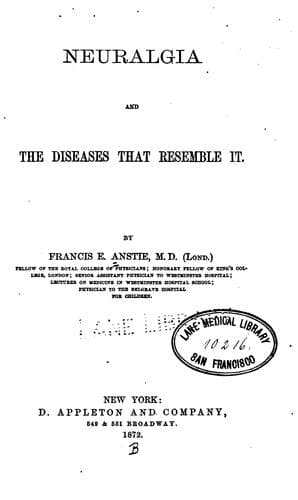
Neuralgia and the diseases that resemble itAnstie, Francis Edmund
Science
Neuralgia and the diseases that resemble it
Anstie, Francis Edmund
Neuralgia
An attack of erysipelas, strictly limited to the district of the painful
nervous branches, then set in. From that moment the neuralgic attacks
became less frequent and severe. A second similar onset of erysipelas
occurred some three or four weeks after the first. Finally, the
neuralgia disappeared about four months after its first occurrence, and
the menses reappeared in tolerable abundance about the same time. About
a fortnight before this the patient had discovered that her right eye
was dim; as the photophobia had previously disabled her from opening the
eye, she could not be sure how long this dimness had existed. At the
time of her visit to me the cornea was blurred with a large patch of
interstitial lymph, with the remains of a superficial ulcer in the
centre; the iris was turbid and discolored, showing the traces of recent
but past iritis; the pupil was regular in form and active to light; the
conjunctiva was slightly congested. Ophthalmoscopic observation was
attempted by a skilled observer, but could not be satisfactorily carried
out, from the turbid state of the media. The conjunctiva was slightly
congested. In place of the lachrymation that had prevailed during the
neuralgic period, there was a remarkable insensibility of the lachrymal
apparatus, for the patient had noticed that the smell of onions, which
would make the other eye weep profusely, had no influence on the
affected one.
The family history of this patient is a most remarkable one. All the
members of her mother's family, for two generations back, had died at
middle age, either from apoplexy or some disease involving hemiplegia.
This case has, by a mistake, not been added to the list of twenty-two
private cases in which the family history was carefully investigated,
that will be found in the chapter on Pathology; this arose from the fact
that the patient was not properly under my care, but was sent to me as a
medical curiosity; the notes of her case were therefore taken in a
different book from the others. The case certainly ought to be taken as
a counterpoise to such a one as No. XVI. in the list, which is that of a
gentleman who suffered from the most complicated neurotic maladies
(asthma, angina pectoris, facial neuralgia, more than once attended with
erysipelas), but whose family history, so far as it was known, presented
no traces of tendency to neurotic disease.
To these two cases of inflammation, secondary to neuralgia, I shall add
a third, which is even more interesting, and which came under my notice
not long since.
Public-domain text, read in full here on John Shaqi.
Reviews
Reviews
No reviews yet
Be the first to share your thoughts on this work.
Elsewhere in the archive
Join the Discussion
Join the discussion
Sign in to leave a comment or review.
Sign InorCreate an account