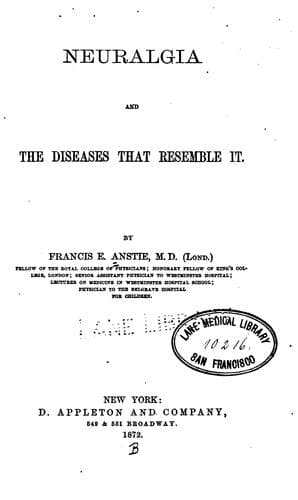
Neuralgia and the diseases that resemble itAnstie, Francis Edmund
Science
Neuralgia and the diseases that resemble it
Anstie, Francis Edmund
Neuralgia
CASE I.--A woman, aged sixty-three, presented herself in the out-patient
room at Westminster Hospital, suffering from neuralgia of ten days'
standing (which for the present, however, seemed to have abated
considerably), but asking advice chiefly for an erysipelatoid
inflammation which had come on a day or two before, and occupied the
area of the painful nerve-district. The neuralgia had affected the
supra-orbital nerve, running up toward the vortex, and the
auriculo-temporal branch of the third division of the fifth; although
there was no very acute pain present at this time, pressure over the
supra-orbital notch, or at a point just in front of the ear, would at
once cause a brief paroxysm of pain. It was curious to find that there
was a thickened and tender spot over the malar bone (and corresponding
to the exit of some nerve filaments from the bone) which had never been
the seat of spontaneous neuralgia, but pressure here sent a dart of pain
into the auriculo-temporal and supra-orbital nerves. The inflammation
was markedly limited to the general area of distribution of the twigs of
the auriculo-temporal and of the ophthalmic division; it was of a
continuous deep-red color, and attended with much thickening of the
skin. The conjunctiva was intensely congested, and there were
lachrymation and very marked photophobia, but there were no signs of
iritis, and no corneal clouding.
CASE II.--M. W., a woman, aged forty-two, well-nourished and
healthy-looking, married and had one child; had never suffered any
serious ailment except once, about five years previously. She then had a
decided attack of "erysipelas," very accurately limited to the right
half of the face. Five months before coming to me she sustained a severe
shock from being thrown out of a chaise, without suffering any external
or visible damage. An hysterical tendency, which she had always
possessed, became more marked; it revealed itself by palpitations,
occasional dysphagia, and a disposition to weep causelessly. The menses
were flowing at the time of the accident; they ceased abruptly soon
after (they had been scanty for some time previously), and did not recur
till four months later. The hysteric disturbance progressively increased
during a fortnight, and then the patient was attacked with violent
intermittent neuralgia, commencing in the eyeball and spreading over
the district supplied by the branches of the first and second divisions
of the trigeminus. The pain was accompanied by intense conjunctival
congestion and photophobia [Dr. Handfield Jones remarks that
photophobia, in his experience, is only a rare accompaniment of facial
neuralgia. I have latterly come to the same opinion. Redness of the eye
and lachrymation are very common; true photophobia uncommon. Notta's
experience would seem to have been similar]. It lasted on the first day
fourteen hours, and returned daily for the next fifteen or sixteen days.
Public-domain text, read in full here on John Shaqi.
Reviews
Reviews
No reviews yet
Be the first to share your thoughts on this work.
Elsewhere in the archive
Join the Discussion
Join the discussion
Sign in to leave a comment or review.
Sign InorCreate an account