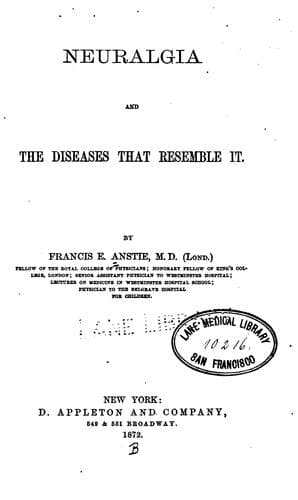
Neuralgia and the diseases that resemble itAnstie, Francis Edmund
Science
Neuralgia and the diseases that resemble it
Anstie, Francis Edmund
Neuralgia
A. Hediger, aged twenty-four, a moderately strongly-built young woman,
seen first in August, 1860. From her own and her mother's account, it
seemed she had long suffered from convulsive attacks that did not appear
to have been truly epileptic. Some days previously her left eye became
very painful, and the sight failed, without any inflammatory symptoms.
On inspection the pupil was somewhat dilated, the eye somewhat
hypermetropic, fundus normal; No. 5, Jager's type, was read with
difficulty. Wegner could not explain the condition. At the end of
October the eye was much worse; after severe paroxysms of pain, No. 16
type was the smallest legible, the field of vision was decidedly limited
in all directions, but especially on the inner and upper portions. An
unusually long hysteric attack was now observed. The patient was for
twenty-four hours in a half-sleep, the extremities, meantime, were much
jerked, the speech sometimes coherent and sometimes incoherent; she
cried out to her friends, etc., but had no severe convulsion-fit with
spasm of glottis. She was removed to the hospital, where she stayed six
weeks. The hysteria improved under treatment with valerian and morphia
(Prof. Greisinger had confirmed the opinion that there was no true
lesion of the centres), but the neuralgia of the globe was
extraordinarily severe, both day and night. From January to June, 1861,
Wegner saw her occasionally. The visual power of the left eye fluctuated
between 15 and 19 Jager. Field of vision very limited. Pupil very
dilated and insensitive, the globe painful to the touch, and injected.
The right eye weakly hypermetropic; normal field of vision, normal
pupil, no pain. The scene suddenly changed on the 29th of June. She was
attacked with fearful pain, and an enormous mydriasis with extreme
amblyopia of the right eye; the fingers could hardly be counted when
placed quite close. The optic disc appeared somewhat cloudy, with very
evident venous pulsation. The mydriasis, amblyopia, and neuralgia lasted
some time, while simultaneously the left eye could only read 19-17 type,
but was painless. The pathology seemed quite obscure, and the surgeon
remained almost passive till August, when he performed paracentesis on
the left eye. The patient could distinguish fingers at that time at a
foot's distance with the right eye; with the left read No. 11, but
suffered fearful pains. These diminished after the puncture; the eye
could read No. 20 next day, and improved after that to 19; the pains
recurred in the next day, but for the first time ceased to disturb
sleep. The scene again changed in the most surprising manner on the 27th
of August. The most frightful pain again attacked the left eye. The
pupil was dilated to the maximum (far beyond what occurs in oculo-motor
paralysis); the globe was extremely painful on touch, visual power
fallen to 19 Jager. On the other hand, the right eye had a normal pupil,
was painless, and could read No. 12. Paracentesis of the left eye
Public-domain text, read in full here on John Shaqi.
Reviews
Reviews
No reviews yet
Be the first to share your thoughts on this work.
Elsewhere in the archive
Join the Discussion
Join the discussion
Sign in to leave a comment or review.
Sign InorCreate an account