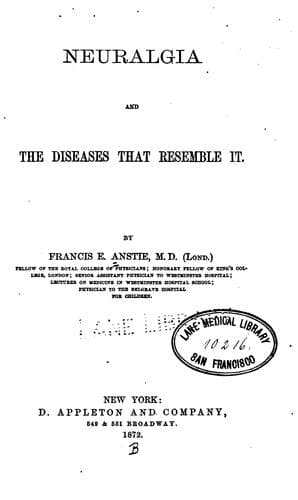
Neuralgia and the diseases that resemble itAnstie, Francis Edmund
Science
Neuralgia and the diseases that resemble it
Anstie, Francis Edmund
Neuralgia
15 and mere finger-counting without any ophthalmoscopic appearances.
A number of paracentesis and subcutaneous injections of morphia (which
last were the more indicated as the supra-orbitalis was tender on
pressure) always brought relief merely for a few hours. On the 19th of
April, 1864, vision being complete in right eye, and No. 19 in left,
Wegner punctured the latter. On the 2d of May the eye read No. 10
slowly, the pains had gone and not returned, the pupil became smaller.
On the 31st of March, 1865, the patient was pronounced well; the eye was
painless, the pupil somewhat larger than the other; the finest type
could be read when looked at very close.
3. The next group of affections secondary to neuralgia are the paralysis
of muscles. These are pretty common; I find them in twenty-eight of the
hundred cases which have been referred to. But of these twenty-eight
instances of paralytic affections no less than twelve were connected
with neuralgia of the trigeminus, and in most of these it was one or
more of the muscles connected with the eye that were affected. Sciatica
is nearly always attended with much weakening of voluntary power of the
muscles of the thigh and leg; and in some instances this reaches to
decided or even complete paralysis. In looking for this phenomenon we
must be very careful that we do not mistake the mere reluctance to move
the limb, on account of the painfulness of all movements, for true
paralytic weakness of nerve and muscle. And it is also necessary to bear
in mind, in prolonged cases, the probability that much of the weakness
may have been caused by degeneration of the muscles owing to forced
inaction. Still, there is a class of secondary paralyses that are in no
way to be confounded with such effects as these: for instance, it
occasionally happens, almost in the very first onset of severe sciatic
pain, that the limb hangs absolutely helpless; and in one such case
lately, being struck with the completeness of the loss of power, I
tested the Faradic irritability by directing a sharp current on
comparatively exposed portions of the painful nerve (_e. g._, in the
popliteal space, and behind the head of the fibula), and elicited only
the most feeble contractions, entirely unlike what the same current
evoked in the opposite limb. I regret that I have as yet found it
impossible to carry out a regular inquiry as to the sensibility to the
different currents of motor nerves which are centrally connected with
neuralgic sensory nerves.
Public-domain text, read in full here on John Shaqi.
Reviews
Reviews
No reviews yet
Be the first to share your thoughts on this work.
Elsewhere in the archive
Join the Discussion
Join the discussion
Sign in to leave a comment or review.
Sign InorCreate an account