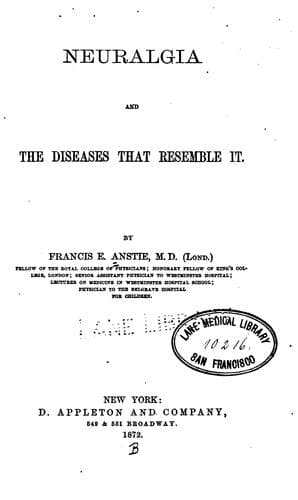
Neuralgia and the diseases that resemble itAnstie, Francis Edmund
Science
Neuralgia and the diseases that resemble it
Anstie, Francis Edmund
Neuralgia
Muscular viscera which are composed of unstriped fibre, like the
intestines, or of a mixture of striped and unstriped, like the heart,
are probably very liable to a secondary paralytic influence from certain
special neuralgiæ. It is ascertained that the pain of a certain degree
of severity in the branches of the fifth may absolutely stop the heart's
action for a moment--an effect which is succeeded, usually, by violent
and disorderly pulsations. I have myself once known the operation of
"pivoting" a tooth, which gave frightful pain, cause instantaneous and
most alarming arrest of the heart's motion, which for a minute or two
seemed as if it were going to be fatal. But the variety of visceral
paralysis which is probably far the most frequent is secondary paralysis
of the bladder, from neuralgia in one or other of the pelvic organs, or
of the external genitalia; and next to this comes paralytic distension
of the cæcum, colon, or rectum, secondary to various abdominal and
pelvic neuralgic affections. In one instance of acute ovarian neuralgia
that I saw, the paralytic distention of the colon was by far the most
remarkable circumstance, so enormously was it developed; and for some
days after the neuralgia had ceased, and when the flatulence had nearly
disappeared, the intestine remained absolutely torpid.
4. Convulsive actions of muscles, as every one knows, are very common
complications of neuralgia. In trigeminal neuralgias these may be
observed (according to the division or divisions of the nerve that are
affected) in the proper muscles of the eye, or in those supplied by the
fourth and sixth nerves, or (perhaps only when two or three divisions
of the fifth are neuralgic at once) by the portio dura. It is curious,
however, that those formidable spasmodic affections of the face which
belong to the same order as torticollis and writer's cramp, are not
frequently, if ever, directly associated with trigeminal neuralgia. The
only connection between them seems to be that these peculiar spasmodic
affections are only developed in highly-neurotic families, some of whose
members are almost sure to be found suffering from some form of regular
neuralgia. In severe sciatica it has several times happened to me to see
convulsive action of the flexors, bending the leg spasmodically upon the
thigh. And in a very large proportion of all neuralgias, wherever
situated, attentive observation of the patient during the paroxysms will
detect the existence of local twitching or local spasm of muscles,
though these may be slight in degree.
Public-domain text, read in full here on John Shaqi.
Reviews
Reviews
No reviews yet
Be the first to share your thoughts on this work.
Elsewhere in the archive
Join the Discussion
Join the discussion
Sign in to leave a comment or review.
Sign InorCreate an account