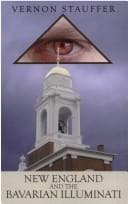
New England and the Bavarian IlluminatiStauffer, Vernon
History
New England and the Bavarian Illuminati
Stauffer, Vernon
Illuminati; New England -- Church history; Thesis (Ph. D.)
through which this work passed is in itself a gauge of its claim upon
popular interest. After the fall of the Directory, and after he had
given his pledge of fidelity to the new government, Barruel again was
permitted to return to France. With a view to healing the schism in
the French church which the Revolution had produced, he championed the
cause of the government in a work entitled, _Du Pape et ses droits
religieux_, 1803. As the Napoleonic regime drew towards its close,
Barruel came to be regarded as an _emigré_ priest, and suffered arrest
at the hands of the government. In August, 1816, Barruel was allowed
to make his profession in the Society of Jesus. Shortly before this he
wrote to its General: “Je m’étais toujours regardé comme lié par mes
voeux, sans cesser d’être vraiment Jésuite, ce qui heureusement a fait
pour moi une douce illusion dans laquelle je remercie Dieu de m’avoir
laissé vivre jusqu’ au moment où vous vous prêtez avec tant de bonté à
la demande que j’ai faite pour ma profession.” (_La Compagnie de Jésus
en France, Histoire d’un siècle, 1814–1914_, Par Joseph Burnichon,
S.J., Tome 1^{er}, Paris, 1914, pp. 74 _et seq._) The last years of
Barruel’s life were spent in retirement. A list of his writings may be
found in Quérard’s _La France Littéraire_, Tome Premier, pp. 196, 197,
and a more elaborate one, in Sommervogel, _op. cit._ i, coll. 930–945.
[547] Barruel, _op. cit._, pp. i, vi.
[548] _Ibid._, pp. xiii _et seq._
[549] Barruel’s term was _Sophistes_.
[550] Barruel, _op. cit._, pp. xiv, xv.
[551] _Ibid._, p. 2.
[552] _Ibid._, p. 1.
[553] Barruel’s main reliance is the correspondence of Voltaire, as
published in the edition of Kehl.
[554] Barruel, _op. cit._, vol. i, pp. 25 _et seq._
[555] _Ibid._, pp. 26, 27, 33.
[556] _Ibid._, pp. 54 _et seq._ Barruel represents the Encyclopedists
as arguing that force could not be employed until there had first been
a revolution in all religious ideas; hence _L’Encyclopédie_, with
all its insinuating doubts, its artful cross-references, its veiled
impiety, was planned to give the first great impulse in that direction.
Thus the old forms of thought would perish “as it were, by inanition;”
later, the laying of the axe to the altar would not be hazardous.
[557] _Ibid._, pp. 75 _et seq._
[558] _Ibid._, pp. 127 _et seq._
[559] _Ibid._, pp. 163 _et seq._ According to Barruel, the conspirators
numbered among their adepts the following: Joseph II of Germany,
Catherine II of Russia, Christian VII of Denmark, Gustave III of
Sweden, Poniatowski, king of Poland, and the landgrave Frederick of
Hesse-Cassel.
[560] _Ibid._, p. 154.
[561] Barruel, _op. cit._, p. 157.
[562] _Ibid._, pp. 321 _et seq._
[563] _Ibid._, vol. ii, pp. 9, 10, 13 _et seq._, 21.
Public-domain text, read in full here on John Shaqi.
Reviews
Reviews
No reviews yet
Be the first to share your thoughts on this work.
Elsewhere in the archive
Join the Discussion
Join the discussion
Sign in to leave a comment or review.
Sign InorCreate an account