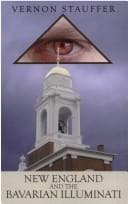
New England and the Bavarian Illuminati — John Shaqi
New England and the Bavarian IlluminatiStauffer, Vernon
History
New England and the Bavarian Illuminati
Stauffer, Vernon
Illuminati; New England -- Church history; Thesis (Ph. D.)
[144] By this time dissenters and Anti-Federalists had largely
consolidated their interests. The political program of the latter drew
upon the former all the suspicions and antagonisms which the Standing
Order entertained toward the foes of Federalism. The acrimonious
discussion which arose at this time over the disposition of the
Western Reserve and the funds thus derived, admirably illustrates the
cross-currents of religious and political agitation in the last decade
of the century. _Cf._ Greene, _The Development of Religious Liberty in
Connecticut_, pp. 380–392.
[145] This is readily explicable in view of the fact that most of the
magistrates were adherents of the Establishment. The comment of Backus
touches the pith of the matter, as dissenters saw it: “Thus the civil
authority in the uppermost religious party in their State, was to judge
the consciences of all men who dissented from their worship.” (_History
of New England_, vol. ii, p. 345.)
[146] _Acts and Laws of the State of Connecticut_, p. 418.
[147] In September, 1818, by the adoption of the new state
constitution, the long wearisome struggle was brought to an end, and
State and Church in Connecticut were separated completely.
[148] This point of view was tersely set forth in the election sermon
preached by the Rev. Mr. Payson, at Boston, May 27, 1778: “Let the
restraints of religion once be broken down, as they infallibly would
be by leaving the subject of public worship to the humours of the
multitude, and we might well defy all human wisdom and power to support
and preserve order and government in the state.”—Quoted by Backus,
_Church History of New England, from 1620 to 1804_ (ed. of 1844,
Philadelphia), pp. 204 _et seq._
[149] The state of feelings shared by the supporters of the
Establishment at the time when the blow fell severing the bond between
the church and state in Connecticut, is vividly expressed by Beecher:
“It was a time of great depression.... It was as dark a day as ever
I saw. The injury done to the cause of Christ, as we then supposed,
was irreparable. For several days I suffered what no tongue can tell
_for the best thing that ever happened to the State of Connecticut_.”
(_Autobiography, Correspondence, etc._, vol. i, p. 304.)
[150] This was the view propounded by President Ezra Stiles, of Yale,
in his election sermon of May 3, 1783: “Through the liberty enjoyed
here, all religious sects will grow up into large and respectable
bodies. But the Congregational and Presbyterian denominations, however
hitherto despised, will, by the blessing of Heaven continue to hold
the greatest figure in America, and, notwithstanding all the fruitless
labors and exertions to proselyte us to other communions, become more
numerous than the whole collective body of our fellow protestants in
Europe.” (Quoted by Backus, _History of New England_, vol. ii, p. 312.)
Public-domain text, read in full here on John Shaqi.
Reviews
Reviews
No reviews yet
Be the first to share your thoughts on this work.
Join the Discussion
Join the discussion
Sign in to leave a comment or review.
Sign InorCreate an account