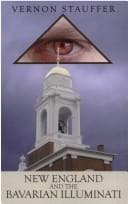
New England and the Bavarian IlluminatiStauffer, Vernon
History
New England and the Bavarian Illuminati
Stauffer, Vernon
Illuminati; New England -- Church history; Thesis (Ph. D.)
During the eighteenth century the progress of religious thought in New
England in the direction of liberal positions was marked. Near the
beginning of the century, in his _Ratio Disciplinae_, Cotton Mather
was able to speak confidently of the solid and compact character of
religious opinion in his generation, and felt free to dispose of
the subject with a few general statements regarding the universal
adherence of the churches of New England to the orthodox standards
of the mother country. He made the added comment: “I can not learn,
That among all the Pastors of Two Hundred Churches, there is one
Arminian: much less Arian, or a Gentilist.”[152] At the end of the
century, it is very certain that no such all-inclusive generalization,
by the widest stretch of the imagination, would have been possible.
Indeed, when a noted Philadelphia minister of the day, the Reverend
Ashbel Green, visited New England in 1791, he found an aptitude for
polemical discussion on the part of the clergy which impressed him as
most extraordinary. Through his contact with the Boston Ministerial
Association he encountered “Calvinists, Universalists, Arminians,
Arians,” and at least one “Socinian,” all participating in pleasant
social intercourse, despite their radical differences of religious
opinion. To the mind of the visiting Philadelphia clergyman the
situation was explicable only on the basis of an extreme laxness in
the matter of religious sentiments and doctrines, a judgment which
obviously requires some modification in view of the predilection for
doctrinal controversy which he himself remarked.[153]
From the days of the Great Awakening, the lines of doctrinal cleavage
had grown increasingly distinct in the religious thought of New
England. Apart from those effects of the revival which already have
been noted,[154] it may be said that the one really permanent result of
that notable wave of religious enthusiasm was the polemical controversy
which it precipitated.[155] The question concerning the “means of
grace,” around which the controversy in its initial stage raged,[156]
became larger and more complicated by virtue of the massive system of
theology which Jonathan Edwards developed upon the fundamental notion
of the utter worthlessness of man, due to his depravity and consequent
helplessness.
Public-domain text, read in full here on John Shaqi.
Reviews
Reviews
No reviews yet
Be the first to share your thoughts on this work.
Join the Discussion
Join the discussion
Sign in to leave a comment or review.
Sign InorCreate an account