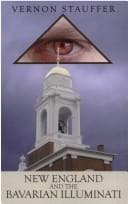
New England and the Bavarian Illuminati — John Shaqi
New England and the Bavarian IlluminatiStauffer, Vernon
History
New England and the Bavarian Illuminati
Stauffer, Vernon
Illuminati; New England -- Church history; Thesis (Ph. D.)
The wash of the wave of the great deistic controversy on the other
side of the Atlantic was not without its effect upon the religious
thought of New England. The direct evidence of this is, however, much
more elusive than one might at first suppose.[159] That the reading
public was acquainted with the writings of the great English deists,
Herbert, Chubb, Shaftesbury, Tindal, Wollaston, Toland, Hume, is
clear from references to their works which appear with considerable
frequency in the private and public records of the day; but invariably
these references are made in a more or less casual manner, and, for
the most part, in connection with sweeping generalizations made by the
clergy respecting the prevailing scepticism of the age. Apart from such
allusions and the appearance of titles in the lists of booksellers
who were advertising their stocks in the newspapers, it would be
difficult to cite specific evidence, Thomas Paine’s _Age of Reason_
alone excepted, to the effect that the impact of English deism upon the
thought of New England was anything like direct.
The amount of independent literary expression which the doctrines of
deism obtained in New England was practically negligible.[160] The
quality was even less noteworthy. Ethan Allen’s _Reason the Only
Oracle of Man_,[161] published in 1784, was perhaps the only production
of native orig into which anything like general attention was accorded;
and the evident inability of this work to root itself deeply in the
thought of the people, despite the prestige due to the author’s
Revolutionary record, was demonstrated the moment Paine’s more serious
work began to circulate in this country. The crudeness of Allen’s
style, coupled with the ferocity of his onslaught on the advocates and
absurdly credulous devotees of supernaturalism, as Allen regarded the
orthodox party of his day, went far toward determining the attitude
of contempt and high-minded scorn with which his work was generally
treated, when leaders of conservative thought deigned to notice it at
all.[162]
Public-domain text, read in full here on John Shaqi.
Reviews
Reviews
No reviews yet
Be the first to share your thoughts on this work.
Join the Discussion
Join the discussion
Sign in to leave a comment or review.
Sign InorCreate an account