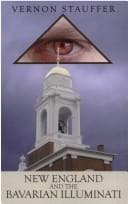
New England and the Bavarian IlluminatiStauffer, Vernon
History
New England and the Bavarian Illuminati
Stauffer, Vernon
Illuminati; New England -- Church history; Thesis (Ph. D.)
[260] McMaster, _A History of the People of the United States_, vol.
ii, pp. 248 _et seq._ _Cf._ _Works of Fisher Ames_, vol. i, p. 161.
[261] Morse, _The Federalist Party in Massachusetts_, pp. 153 _et seq._
[262] Travelers from abroad who were in the country at this time
remarked the extreme virulence of public and private discussion. De La
Rochefoucault-Liancourt, _Travels through the United States of North
America_, vol. ii, pp. 231 _et seq._ _Cf. ibid._, pp. 75 _et seq._,
256, 359, 381; vol. iii, pp. 23, 33 _et seq._, 74 _et seq._, 156, 163
_et seq._, 250, 274, 366 _et seq._ _Cf._ Weld, _Travels through the
States of North America ... during the years 1795, 1796, and 1797_,
p. 62. Writing specifically of the excited state of the public mind
in February, 1796, the latter observer of our national life said: “It
is scarcely possible for a dozen Americans to sit together without
quarrelling about politics, and the British treaty, which had just been
ratified, now gave rise to a long and acrimonious debate. The farmers
were of one opinion, and gabbled away for a long time; the lawyers
and the judge were of another, and in turns they rose to answer their
opponents with all the power of rhetoric they possessed. Neither party
could say anything to change the sentiments of the other one; the noisy
contest lasted till late at night, when getting heartily tired they
withdrew, not to their respective chambers, but to the general one
that held five or six beds, and in which they laid down in pairs. Here
the conversation was again revived, and pursued with as much noise as
below, till at last sleep closed their eyes, and happily their mouths
at the same time....” (_Ibid._, pp. 58 _et seq._) Such unfavorable
reflections are not to be dismissed as representing prejudiced views of
the case. A habit of intolerance toward political opponents and of all
men who shared contrary opinions, had become one of the characteristics
of the times. The agitation over the treaty went far toward fixing
this habit. The Alien and Sedition Acts, which came a little later,
were the result of an unrestrained freedom of discussion scarcely more
perceptible when they were passed in 1798 than at the time of the heat
produced by the treaty.
[263] Gibbs, _Memoirs of the Administrations of Washington and
John Adams_, vol. i, p. 226, Oliver Ellsworth’s letter to Oliver
Wolcott. Ellsworth reports that the “argument and explanation [of the
treaty], that ‘’tis a damned thing made to plague the French,’ has by
repetition, lost its power.” This could have been true only in a local
sense.
[264] _Cf._ McMaster, _A History of the People of the United States_,
vol. ii, pp. 227 _et seq._, for an ample discussion of this view of the
situation.
Public-domain text, read in full here on John Shaqi.
Reviews
Reviews
No reviews yet
Be the first to share your thoughts on this work.
Elsewhere in the archive
Join the Discussion
Join the discussion
Sign in to leave a comment or review.
Sign InorCreate an account