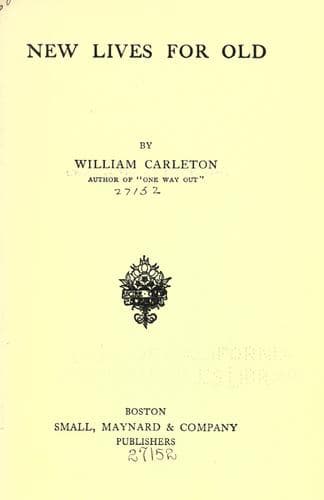
Agriculture, Cooperative -- Fiction; Country life -- Fiction; Farmers -- Fiction; New England -- Fiction; Villages -- Fiction
We wanted a good Dorset ram which would cost in the neighborhood of
a hundred dollars; we wanted a good bull which would cost in the
neighborhood of six hundred dollars. Unless a man went into either
business extensively such an investment wouldn’t pay. It seemed
natural enough then for us all to club together and buy shares. But
if we did this, why shouldn’t we do more? There was the whole problem
of marketing still confronting us. We had solved it in a crude way
last spring but that only served to show us what might be done with a
perfected organization. Out of this was born with scarcely any talk,
scarcely any planning and almost full grown, the scheme which finally
welded us into one compact business firm--the Pioneer Products Company.
The idea had been growing all this time and we didn’t know it. When
we did recognize it, it seemed so natural and obvious that everyone
marveled that we hadn’t thought of it from the beginning. It’s merely
another example of what a rut farming folk have fallen into.
There isn’t any business on the face of the earth that lends itself so
readily to coöperation as farming. Every country village consists of
a small compact body of men living side by side and almost to a man
engaged in buying the same products, manufacturing the same products
and selling the same products to the same market. And these products
are the universal necessities of life. It might be possible for men to
get along without coal, without oil, without steel, even without beef,
but they surely could not get along without wheat and corn, without
vegetables, without eggs and milk. And yet these communities instead of
holding the world by the throat are themselves the prey of the world
even with their own products. With common interests, common foes, with
a common plant and a common organization they still are the common
victims of a hundred diversified outside interests. This is solely
because the outside interests--like the banks--are allowed to treat
with them as small weak units instead of as one large strong unit. And
this after coöperation has been taught them by their government, by
every business in the land, by every labor organization. It is, as I
have said, this branch of the pioneer spirit which has been both their
salvation and their undoing. But that it is possible both to preserve
this and curb it we proved to our satisfaction with the Pioneer
Products Company.
Public-domain text, read in full here on John Shaqi.
Reviews
Reviews
No reviews yet
Be the first to share your thoughts on this work.
Elsewhere in the archive
Join the Discussion
Join the discussion
Sign in to leave a comment or review.
Sign InorCreate an account