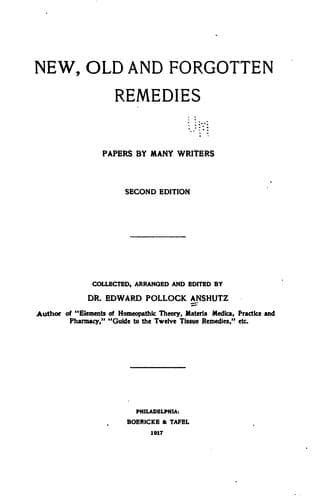
New, Old, and Forgotten Remedies: Papers by Many Writers
Science
New, Old, and Forgotten Remedies: Papers by Many Writers
Homeopathy -- Materia medica and therapeutics
Of all mineral waters those of Levico are distinguished, not only by
their contents of these three elements, arsenic, iron and copper, but
they are remarkable for the state of combination in which they occur.
Situated in South Tyrol, on the confines of Italy, Levico has for many
years been a favorite sanitorium of the Italian medical profession for
their nervous and skin patients. Of late years Levico water has also
been increasingly recognized by the German and Austrian faculty, among
whom Bamberger, Billroth, Hebra, Nussbaum, and others testify to the
extraordinary remedial activity of the waters, favoring assimilation,
increasing nutrition, and in chronic and dyscratic skin diseases
functioning as antiseptic or astringent.
Merely as an internal medication _Levico_ water has, however, proved so
satisfactory that it is a recognized member of the pharmacopoeia in
many German and Austrian hospitals and clinics. Thus Professor Nussbaum,
of Munich, writes that '_Levico_ water is given in my orthopædic
institute in doses of two or three ounces to scrofulous and anæmic
children. The water is well tolerated, and in spite of the smallness of
the dose the result is, in many cases, very evident.' Professor
Eulenberg, of Berlin, finds _Levico_ water especially satisfactory in
chorea minor in children and at the age of puberty, as well as for
hysterical neuralgia and spasms. A very copious testimony of like nature
has been borne respecting _Levico_ water.
LATHYRUS SATIVUS.
NAT. ORD., Leguminosæ.
COMMON NAMES, Wild Vetch. Chick pea.
PREPARATION.--Trituration of the dried pea.
(Dr. W. A. Dewey contributed the following paper
concerning this remedy to the _Medical Century_, 1899):
HISTORY AND DESCRIPTION OF EFFECTS,
The _Lathyrus_ is a vetch, and a member of the leguminosæ family growing
in India.
This remedy, which produces a perfect picture of certain spinal
affections, has been known for over a century. In _Christison's
Toxicology_ it is stated that it causes paraplegia, dragging gait,
turning-in of the toes, stiffness and semi-flexion of the knee-joints.
The attention of the homoeopathic profession was directed to the drug
as a possible remedy in paraplegia, in the _British Journal of
Homoeopathy_, Vol. III. Here is found an account of a wheat famine in
India, where the peas of the plant were substituted for wheat and used
as a food. Those who subsisted on it were taken, even during sleep,
with sudden paralysis of the lower limbs; this occurred without
warning, in young men more than in young women, and was never recovered
from. Another observer records fifty cases who had eaten the _Lathyrus_
bread and all stated that they became paralytic during the wet season of
the country, that they went to bed quite well and awoke with stiff legs,
unsteady gait, and aching, but no severe pain. The upper extremities
were free.
Public-domain text, read in full here on John Shaqi.
Reviews
Reviews
No reviews yet
Be the first to share your thoughts on this work.
Elsewhere in the archive
Join the Discussion
Join the discussion
Sign in to leave a comment or review.
Sign InorCreate an account