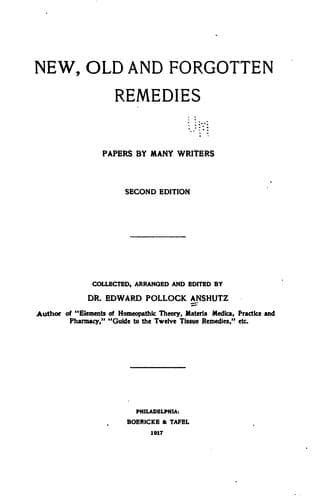
New, Old, and Forgotten Remedies: Papers by Many Writers
Science
New, Old, and Forgotten Remedies: Papers by Many Writers
Homeopathy -- Materia medica and therapeutics
Another who saw the disease in Algeria and described the symptoms found
in ten cases observed that they came on suddenly, in damp weather, with
some pains in the loins, trembling, motor paralysis and exaggerated
reflexes. He attributed these phenomena to an acute transverse myelitis
with degenerative changes in the cord.
A German writer states that the drug produces disturbances of nutrition
of the muscles of the lower extremities, paresis, and that the muscles
of the trunk and neck and face remain unaffected. Sensation remains
normal. It seems to produce a sclerosis of the pyramidal tracts of the
cord.
In animals the same condition is found; namely, paralysis of the hind
legs. Pigs drag their hind legs and horses give out.
AGGRAVATED SYMPTOMATOLOGY.
From all the sources which I have been able to find, the following seem
to be the symptoms caused by the drug:
Sudden loss of power in the lower extremities, from the waist down.
Tremulous, tottering gait.
Great exaggeration of the reflexes.
Stiffness and lameness of the ankles and knees.
Excessive rigidity of the legs; flexion difficult; spastic gait, the
legs becoming interlocked, and walking is difficult or impossible.
Sudden onset of the trouble, and apparent aggravation in cold and damp
weather.
Emaciation of the gluteal muscles also observed.
Those having taken it walked on the metatarso-phalangeal articulation,
the heel not touching the ground.
Impossible to stand steady; swayed from side to side, but closing the
eyes had no effect. This with the exaggerated reflexes would exclude its
use in locomotor ataxia.
Debility and tremors of the legs.
Rigidity of the adductors of the thighs.
Staggering gait, with eyes fixed on the floor.
Could not extend or cross the legs when sitting.
Sensibility unimpaired.
CORRESPONDENCE TO SPINAL DISORDERS.
From these symptoms it will be seen that the effects of the drug
correspond to many spinal symptoms, but more especially to what is known
as spastic paraplegia. Indeed, Struempel asserts that it produces a
perfect picture of this disease.
It is not so often that such a perfect picture of a disease can be had
as in this instance. The disease itself is easily recognized by the
stiff, spastic gait; the spasm of the adductors, causing the knees to
strike each other, or to become locked, causing the patient to fall; the
shuffling of the feet; the excessive muscular rigidity and the other
well-known symptoms of paraplegia.
Therefore, reasoning from our law we would expect the drug to be of
service in such cases, and although our pathogenesis of it is coarse we
may be permitted to apply it to a disease whose symptomatology is of the
coarse order; for it is often difficult to elicit any fine and
characteristic symptoms in diseases like ataxic and spastic paraplegia.
Public-domain text, read in full here on John Shaqi.
Reviews
Reviews
No reviews yet
Be the first to share your thoughts on this work.
Elsewhere in the archive
Join the Discussion
Join the discussion
Sign in to leave a comment or review.
Sign InorCreate an account