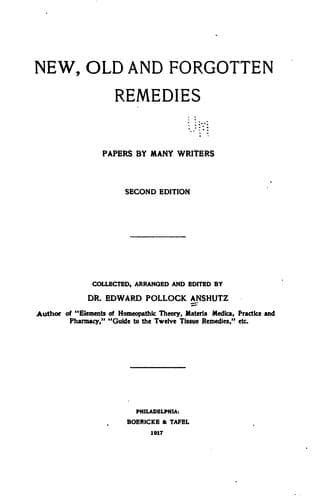
New, Old, and Forgotten Remedies: Papers by Many Writers
Science
New, Old, and Forgotten Remedies: Papers by Many Writers
Homeopathy -- Materia medica and therapeutics
It has been recognized as a remedy by but few of our writers on nervous
diseases. O'Connor finds that marked benefit follows its use in old
cases of myelitis with marked spastic symptoms. Bartlett, in _Goodno's
Practice_, recommends it in excessive knee-jerk and rigidity. Hart
speaks of it as a remedy in locomotor ataxia, but the absence of sensory
symptoms and the presence of exaggerated reflexes would seem to
contra-indicate it in this disease. He also speaks of it in spinal
anemia, giving as symptoms: "Numbness, followed by pain in the lower
extremities; sensation of a band around the body; unable to step or
distinguish one limb from another"--symptoms which I am unable to find
that the remedy produced. Elliott also speaks of it.
CLINICAL RÉSUMÉ.
The clinical record of _Lathyrus_, though very meagre, gives great hope
that it may prove useful in numerous cases of bed-ridden paraplegiacs
and in infantile spinal paralysis, as well as in certain forms of
myelitis.
The following is a résumé of all that I can find published:
I. Case of spinal paraplegia, relieved.
II. A case of multiple sclerosis in a young man of twenty-eight who had
been ill seven years and unable to walk for six years was greatly
benefited by _Lathyrus_ [Latin: ezh]x.
III. Case of paraplegia, could walk after taking the remedy for some
time.
IV. Case of paraplegia, no improvement.
V. Rheumatic paralysis, with stiff knees, could walk after use of
_Lathyrus_. (Clark _Homoeopathic World_.)
VI. In a case of a clerk with loss of power of the lower limbs, reflexes
exaggerated, knee-jerk violent, locomotion difficult and unsteady,
probably a case of transverse myelitis, _Lathyrus_ [Latin: ezh]x, night
and morning, gave most satisfactory results. The patient could walk a
mile without assistance. (Simpson, _Homoeopathic Review_.)
VII. In a man aged fifty-two who had been unable to walk for six years,
the paraplegia coming on after a "stroke" from exposure to wet,
_Lathyrus_ [Latin: ezh]x practically cured in eight months. He had been
tied to a chair for six, and at the time he stopped treatment he was
walking four miles daily. (Blake, _Homoeopathic Review_.)
From the fact that the _Lathyrus_ disease occurs frequently in certain
mountainous regions of Asia it has been remarked that it is akin to
Beri-Beri, which has been traced to eating the _Lathyrus_ bread.
LIATRIS SPICATA.
NAT. ORD., Compositæ.
COMMON NAMES, Dense Button-Snake-root. Gay Feather. Devil's Bit.
PREPARATION.--The root is pounded to a pulp and macerated in two parts
by weight of alcohol.
(The following, by Dr. T. C. Duncan, was called forth by
the publication of an item in _Eclectic Medical Journal_,
stating that twice during the past year _Liatris_ had
given good results in dropsy; in one case, on the second
day, the patient had passed a gallon and a half of urine.
Dr. Duncan's paper was published in the _Homoeopathic
Recorder_ for 1898):
Public-domain text, read in full here on John Shaqi.
Reviews
Reviews
No reviews yet
Be the first to share your thoughts on this work.
Elsewhere in the archive
Join the Discussion
Join the discussion
Sign in to leave a comment or review.
Sign InorCreate an account