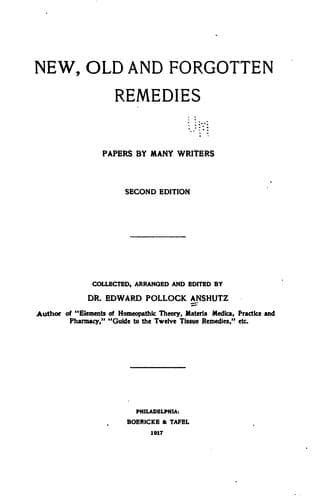
New, Old, and Forgotten Remedies: Papers by Many Writers
Science
New, Old, and Forgotten Remedies: Papers by Many Writers
Homeopathy -- Materia medica and therapeutics
The prime property of the loco is to induce insanity in men or animals
who partake of it. Animals--mules, horses, sheep and cattle--avoid it
naturally, and under ordinary circumstances never touch it. But in the
winter, when an inch or two of snow has covered the grass, these green
bunches of loco standing clear and above the snow are tempting bits to
animals which are going about half starved at the best. Even then it is
not common for them to eat it. Still, some do and it at once creates an
appetite in the victim similar in its intense force to the alcohol habit
in mankind.
Once started on the downward path of loco a mule will abandon all other
forms of food and look for it. In a short time its effects become
perfectly apparent. You will see a locoed mule standing out on the
shadowless plain with not a living, moving thing in his vicinity. His
head is drooping and his eyes are half closed. On the instant he will
kick and thresh out his heels in the most warlike way. Under the
influence of loco he sees himself surrounded by multitudes of
threatening ghosts and is repelling them.
The mind of the animal is completely gone. He cannot be driven or worked
because of his utter lack of reason. He will go right or left or turn
around in the harness in spite of bits or whip, or will fail to start or
stop, and all in a vacant, idiotic way devoid of malice. The victim
becomes as thin physically as mentally, and after retrograding four or
five months at last dies, the most complete wreck on record. Many
gruesome tales are furnished of cruel Spanish and Mexican ladies who, in
a jealous fit, have locoed their American admirers through the medium of
loco tea. Two or three cases in kind are reported in the Texas lunatic
asylum.
OENTHE CROCATA.
PREPARATION.--The fresh root is macerated in two parts by weight of
alcohol.
(The following paper on _OEnanthe crocata_ was kindly
sent to the editor by Dr. W. A. Dewey, of the Ann Arbor
University, Michigan):
_OEnanthe crocata_ belongs to the large family of the Umbelliferæ
which furnishes us with _Conium_ and _Cicuta_. It grows in marshy
localities in England and France. In Botanical works of the 16th and
17th centuries it was often confounded with _Cicuta virosa_, an error
which has even been made in more recent times, in fact, only one
Botanist of the 19th century described the plant with sufficient
exactness for its recognition, and that was DeLobel, who published his
Botany in 1851. It is one of the largest plants of the family, being 3
to 5 feet high. Our tincture is from the fresh root.
Public-domain text, read in full here on John Shaqi.
Reviews
Reviews
No reviews yet
Be the first to share your thoughts on this work.
Elsewhere in the archive
Join the Discussion
Join the discussion
Sign in to leave a comment or review.
Sign InorCreate an account