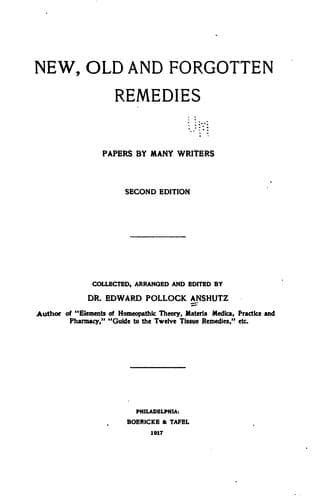
New, Old, and Forgotten Remedies: Papers by Many Writers
Science
New, Old, and Forgotten Remedies: Papers by Many Writers
Homeopathy -- Materia medica and therapeutics
HISTORICAL.--_OEnanthe_ was known to Galen and Dioscorides, and
numerous citations might be made to show that the drug was used from the
earliest times in various affections, affections that nearly every drug
was tried in, but it is in the "Cyanosura Materia Medica of Boecler,
published in 1729," that we first find a hint as to its true action.
"Those who ate much of it were taken with dark vertigos, going from one
place to another, swaying, frightened, turning in a circle as Lobilus
pretends to have seen."
Hahnemann, in his "Apotheker Lexicon" (Leipzig, 1793), says of the drug:
"It is said that the whole plant is poisonous and causes vertigo,
stupefaction, loss of force, convulsions, delirium, stiffness,
insensibility, falling of the hair, and taken in large quantities will
cause death."
He says further: "That, administered with great circumspection, it
should prove useful in certain varieties of delirium, vertigos and
cramps."
This is interesting coming from Hahnemann at the time when he had
discovered the law, but had not as yet given it to the world.
_OEnanthe_ was considered in the last century as one of the most
pernicious plants of Europe, especially for cattle, who, having eaten
it, can neither vomit nor digest it and they soon die in convulsions;
this from the root, however, as they eat the leaves with impunity. It is
interesting to note that animals poisoned with it decompose rapidly.
Much of the following study is taken from a series of excellent papers
on the drug, which have been appearing for over a year in "Le Journal
Belge D'Homoeopathie," from the pen of Dr. Ch. DeMoor, of Alost,
Belgium.
GENERAL ACTION.--From a very large collection of observations of cases
of poisoning with _OEnanthe_, dating from 1556 to the present time and
recorded in "Allen's Encyclopædia," the "Cyclopædia of Drug
Pathogenesy," and in the article of Dr. DeMoor, above mentioned, we find
that _OEnanthe crocata_ produces, almost invariably, convulsions of an
epileptiform character and which are marked by the following symptoms:
Swollen, livid face, sometimes pale.
Frothing at mouth.
Contraction of chest and oppressed breathing.
Dilated pupils or irregular. Eyeballs turned upward.
Coldness of the extremities.
Pulse weak.
Convulsions are especially severe, at first tonic then clonic.
Locked jaws.
Trembling and twitching of muscles.
_OEnanthe_ also produces a delirium in which the patient becomes as if
drunken, there is stupefaction, obscuration of vision and fainting.
The Greek name of the plant signifies "wine flower," and so-called on
account of its producing a condition similar to wine drunkenness, and
there is a difference, so I have heard, between wine and other beverages
in this respect. Hiccoughs are also produced by the drug.
Public-domain text, read in full here on John Shaqi.
Reviews
Reviews
No reviews yet
Be the first to share your thoughts on this work.
Elsewhere in the archive
Join the Discussion
Join the discussion
Sign in to leave a comment or review.
Sign InorCreate an account