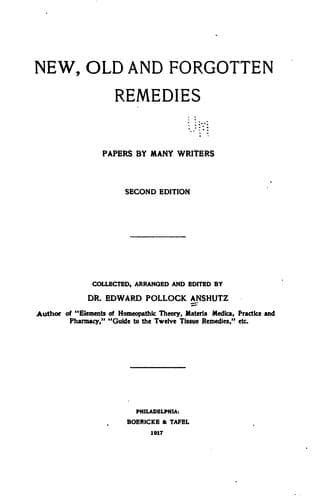
New, Old, and Forgotten Remedies: Papers by Many Writers
Science
New, Old, and Forgotten Remedies: Papers by Many Writers
Homeopathy -- Materia medica and therapeutics
PREPARATION.--The fresh, ripe berries are macerated in twice their
weight of alcohol.
(In 1889 Dr. Napier called attention to _Solanum
Carolinense_ as a remedy in the treatment of epilepsy,
stating that it was used as a domestic remedy in the
South for convulsions and "that he had successfully
prescribed it in his practice." Dr. Charles S. Potts, of
the University of Pennsylvania, contributes a paper
_Therap. Gazette_, Dec., 1895, on the remedy, giving some
new points, from which the following is condensed:)
At the clinic for nervous diseases of the University Hospital, _Solanum
Carolinense_ was tried in a series of twenty-five cases, twenty-one of
which were idiopathic, three organic, and one probably so. Of these,
eight of the idiopathic cases either did not return after the first
visit or else were not under observation sufficiently long to offer a
fair test. In the remaining seventeen cases the following results were
obtained--viz., five, two of them organic, were not improved. In the
remaining twelve the results showed more or less benefit from the use of
the drug. The five cases in which no improvement was noted were
afterwards placed upon other treatment, either antipyrin and bromide of
ammonium or the mixed bromides with amelioration of the symptoms in
four; in the remaining one no drug seemed to be of service. The dose
used at first was 10 drops. This dose was found to be useless, and after
the first few cases they varied from 30 drops to teaspoonful three or
four times daily. No unpleasant effects were observed, excepting a mild
diarrhoea in some cases. This was also noticed by Dr. Herdman. He also
noticed that in large doses the temperature was lowered and the pulse
slowed.
In many epileptics diarrhoea is more of a benefit than otherwise.
The conclusions derived from the results obtained in seventeen cases
are:--
1. That the drug has a decided influence for good upon the epileptic
paroxysm.
2. That this influence is probably not so great or so sure as that
obtained by the use of antipyrin and the bromide salts or even of the
mixed bromides.
3. That in those cases in which it is of service it relieves the
paroxysms, without causing any other unpleasant symptoms, such as are
sometimes caused by the use of large doses of the bromides.
4. That the dose ordinarily recommended is too small, and that as much
as a teaspoonful or more four times daily is often needed to secure
results.
The following are some of the cases in which the remedy seemed to act
beneficially:
Public-domain text, read in full here on John Shaqi.
Reviews
Reviews
No reviews yet
Be the first to share your thoughts on this work.
Elsewhere in the archive
Join the Discussion
Join the discussion
Sign in to leave a comment or review.
Sign InorCreate an account