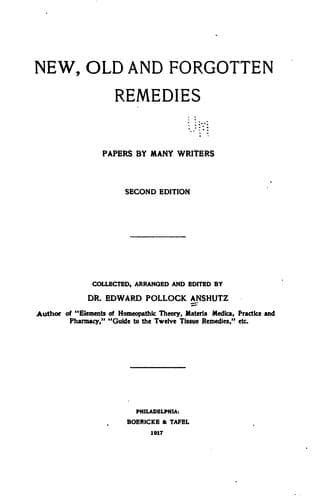
New, Old, and Forgotten Remedies: Papers by Many Writers
Science
New, Old, and Forgotten Remedies: Papers by Many Writers
Homeopathy -- Materia medica and therapeutics
The writer has employed this drug in his private practice for a number
of years with the most gratifying results. He has very rarely found it
to fail when indicated, and on account of his high opinion of the
remedy he has taken great pleasure in thus bringing it prominently to
the attention of the medical profession.
AZADIRACHTA INDICA.
PREPARATION.--The fresh bark is pounded to a pulp and macerated in two
parts by weight of alcohol.
(The following synopsis of _Azadirachta Ind._, is
contributed by P. C. Majumdar, M. D., of Calcutta,
India):
_Azadirachta Indica._ Syn.: Sanskrit, Nimba; Bengala and Hindi, Nim.
Belongs to the natural order Meliaeæ. It is a large tree. Bark is used
for making tinctures from which provings were instituted. The leaves,
bark, wood, roots and fruits, in short, every part of this tree, is
intensely bitter. According to Ayurveda (Hindu System of Medicine) the
different parts of this tree possess different medicinal properties.
Bhava Misra, Charak, Susratha and several other Sanskrit authors agree
that its bark, though very disagreeable in taste, is generally used with
success in cases of lassitude, thirst, cough, fever, loss of appetite,
helmenthiasis, boils, bilious derangements, catarrh, vomiting, cutaneous
diseases, hiccough, gonorrhoea, etc.; its leaves are used in some
forms of ophthalmic disease, helmenthiasis and disorders brought on by
deranged bile or use of poisonous things. A decoction of fresh leaves is
used as a favorite wash to cure old ulcers of long standing. It removes
within a short time the sloughs and promotes the healing. The fruit is
purgative, demulcent, and is used in some forms of cutaneous affections.
A kind of oil is produced from the seed of ripe fruits, and this oil is
said to cure lepra, eczema and some other obstinate skin diseases.
Nim is also praised by some of the Allopathic physicians for its tonic,
antiseptic, astringent and anti-periodic properties. Its febrifuge
action is well-known in our country. Kanirages (native physicians) use
Nim as the principal substance in their febrifuge medicines. The vast
range of its action is chiefly due to azaderine, margocine and katechin,
the three active principles found in this tree. Nim was proved by me and
one of my students, U. C. Bagchi. A full report of the proving was
published in the _Indian Homoeopathic Review_, Vol. iii, No. 1. Here I
give the most reliable and peculiar symptoms obtained in its proving.
Mind: Depressed and forgetful, mistakes in writing and spelling words,
weak and dull, full of anxiety, inactive, could not think or remember
names of persons very familiar, or what has been done in the previous
day. No desire to go out or walk out. Loss of memory.
Public-domain text, read in full here on John Shaqi.
Reviews
Reviews
No reviews yet
Be the first to share your thoughts on this work.
Join the Discussion
Join the discussion
Sign in to leave a comment or review.
Sign InorCreate an account