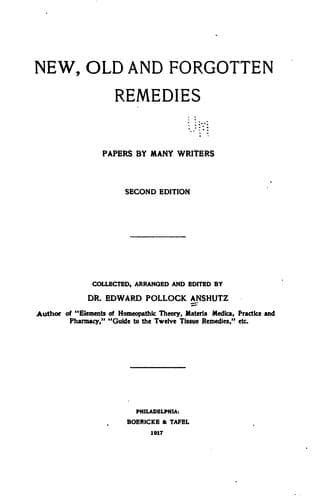
New, Old, and Forgotten Remedies: Papers by Many Writers
Science
New, Old, and Forgotten Remedies: Papers by Many Writers
Homeopathy -- Materia medica and therapeutics
Every time I took a dose of _Calc. ren. pr._ I found that the so-called
tartar on the teeth became detached a few days afterwards. A short while
ago a nodosity, hard as a stone, which had appeared on the extensor
tendon of the right middle finger, about nine months ago, and which
threatened to increase more and more, disappeared. I consider the tartar
on the teeth, calculi renales and arthritic nodosities very similar
morbid products.
In conclusion I beg leave to offer the following remarks:
1. Hahnemann's theory of psora is no chimera, as many theoreticians
would have us believe. I was perfectly healthy previous to my being
infected with itch. What a host of sufferings have I been obliged to
endure after the suppression of the itch!
2. Isopathy deserves especial notice.
It is true, the most suitable homoeopathic remedies afforded me
relief; the incarceration of calculi in the ureter especially was
relieved by _Nux_; but they were unable to put a stop to the formation
of calculi; this result was only attained by the preparation of _Calc.
ren._
CEANOTHUS AMERICANUS.
NAT. ORD., Rhamnaceæ.
COMMON NAMES, New Jersey Tea. Red Root. Wild Snowball.
PREPARATION.--The fresh leaves are pounded to a pulp and macerated in
two parts by weight of alcohol.
(The following by Dr. Majumdar in _Indian Homoepathic
Review_, 1897, illustrates the chief use of this "organ
remedy.")
Recently I had a wonderful case of supposed heart disease cured by
_Ceanothus_. I am indebted to my friend, Dr. Burnett, for the suggestion
of using _Ceanothus_.
A thin and haggard looking young man presented himself to my office on
the 26th of July, 1896. He told me he had some disease of the heart and
had been under the treatment of several eminent allopathic physicians of
this city; some declared it to be a case of hypertrophy of the heart and
some of valvular disease.
Without asking him further, I examined his heart thoroughly, but with no
particular results. The rhythm and sounds were all normal only there was
a degree of weakness in these sounds. Dulness on percussion was not
extended beyond its usual limit. So I could not make out any heart
disease in this man.
On further inquiry, I learned that the man remained in a most malarious
place for five years, during which he had been suffering off and on
from intermittent fever. I percussed the abdomen and found an enormously
enlarged and indurated spleen, reaching beyond the navel and pushing up
the thoracic viscera.
The patient complained of palpitation of heart, dyspnoea, especially
on ascending steps and walking fast. I thought from these symptoms his
former medical advisers concluded heart disease. In my mind they seemed
to be resulted from enlarged spleen.
Public-domain text, read in full here on John Shaqi.
Reviews
Reviews
No reviews yet
Be the first to share your thoughts on this work.
Elsewhere in the archive
Join the Discussion
Join the discussion
Sign in to leave a comment or review.
Sign InorCreate an account