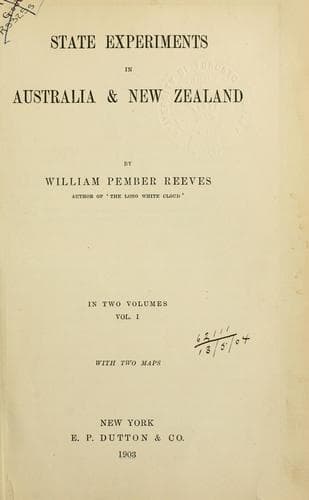
New Zealand -- Description and travel; New Zealand -- History
Then in estimating how far New Zealand country life may be enjoyable
and satisfying we must remember that it is mainly a life out of
doors. On farms and stations of all sorts and sizes the men spend
many hours daily in the open, sometimes near the homestead, sometimes
miles away from it. To them, therefore, climate is of more importance
than room-space, and sunshine than furniture. If we except a handful
of mountaineers, the country worker in New Zealand is either never
snowbound at all, or, at the worst, is hampered by a snowstorm once
a year. Many showery days there are, and now and again the bursts of
wind and rain are wild enough to force ploughmen to quit work, or
shepherds to seek cover; but apart from a few tempests there is nothing
to keep country-folk indoors. It is never either too hot or too cold
for out-door work, while for at least one day in three in an average
year it is a positive pleasure to breathe the air and live under the
pleasant skies.
The contrast between the station of the back-ranges and the country
place of the wealthy freeholder is the contrast between the first
generation of colonial life and the third. The lord of 40,000 acres
may be a rural settler or a rich man with interests in town as well as
country. In either case his house is something far more costly than
the old wooden bungalow. It is defended by plantations and approached
by a curving carriage drive. When the proprietor arrives at his
front door he is as likely to step out of a motor-car as to dismount
from horseback. Within, you may find an airy billiard-room; without,
smooth-shaven tennis lawns, and perhaps a bowling-green. The family
and their guests wear evening dress at dinner, where the wine will
be expensive and may even be good. In the smoking-room, cigars have
displaced the briar-root pipes of our fathers. The stables are higher
and more spacious than were the dwellings of the men of the early
days. Neat grooms and trained gardeners are seen in the place of the
“rouse-abouts” of yore. Dip and wool-shed are discreetly hidden from
view; and a conservatory rises where meat once hung on the gallows.
Public-domain text, read in full here on John Shaqi.
Reviews
Reviews
No reviews yet
Be the first to share your thoughts on this work.
Join the Discussion
Join the discussion
Sign in to leave a comment or review.
Sign InorCreate an account