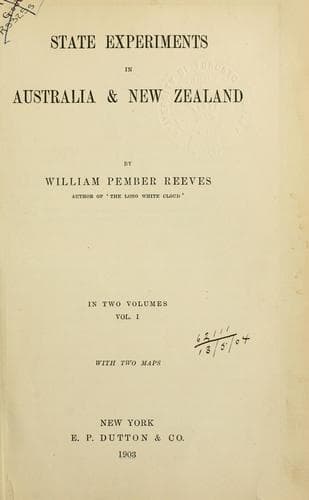
New Zealand -- Description and travel; New Zealand -- History
From the day of its annexation, so disliked by Downing Street, to
the passing of those experimental laws so frowned upon by orthodox
economists, our colony has contrived to attract interest and cause
controversy. A great deal has been written about New Zealand; indeed,
the books and pamphlets upon it form a respectable little library. Yet
is the picture which the average European reader forms in his mind
anything like the islands? I doubt it. The patriotic but misleading
name, “The Britain of the South,” is responsible for impressions
that are scarcely correct, while the map of the world on Mercator’s
Projection is another offender. New Zealand is not very like Great
Britain, though spots can be found there--mainly in the province of
Canterbury and in North Otago--where Englishmen or Scotsmen might
almost think themselves at home. But even this likeness, pleasant as
it is at moments, does not often extend beyond the foreground, at any
rate as far as likeness to England is concerned. It is usually an
effect produced by the transplanting of English trees and flowers,
cultivation of English crops and grasses, acclimatisation of English
birds and beasts, and the copying more or less closely of the English
houses and dress of to-day. It is a likeness that is the work of the
colonists themselves. They have made it, and are very proud of it. The
resemblance to Scotland is not quite the same thing. It sometimes does
extend to the natural features of the country. In the eastern half of
the South Island particularly, there are landscapes where the Scot’s
memory, one fancies, must often be carried back to the Selkirks, the
peaks of Arran, or the Highland lochs of his native land. Always,
however, it is Scotland under a different sky. The New Zealanders live,
on the average, twelve degrees nearer the equator than do dwellers in
the old country, and though the chill of the Southern Ocean makes the
change of climate less than the difference of latitude would lead one
to expect, it is still considerable. The skies are bluer and higher,
the air clearer, and the sun much hotter than in the British
Isles. The heavens are a spacious dome alive with light and wind. Ample
as the rainfall is, and it is ample almost everywhere, the islands,
except in the south-west, strike the traveller as a sunny as well as a
bracing country. This is due to the ocean breezes and the strength of
the sunshine. The average number of wet days in the year is 151; but
even a wet day is seldom without sunshine, it may be for some hours, it
will be at least a few gleams. Such a thing as a dry day without a ray
of brilliance is virtually unknown over four-fifths of the colony. I
once had the felicity of living in London during twenty-two successive
days in which there was neither a drop of rain nor an hour of sunshine.
If such a period were to afflict New Zealand, the inhabitants would
assuredly imagine that Doomsday was at hand. “Truly the light is sweet,
Public-domain text, read in full here on John Shaqi.
Reviews
Reviews
No reviews yet
Be the first to share your thoughts on this work.
Join the Discussion
Join the discussion
Sign in to leave a comment or review.
Sign InorCreate an account