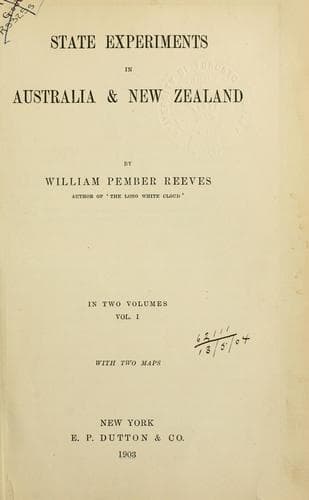
New Zealand -- Description and travel; New Zealand -- History
In a word, the outlook for the Maori, though still doubtful, is by no
means desperate. They will own land; they will collect substantial
rents from white tenants; they will be educated; they will retain the
franchise. At last they are beginning to learn the laws of sanitation
and the uses of ventilation and hospitals. The doctors of the Health
Department have persuaded them to pull down hundreds of dirty old huts,
are caring for their infants, and are awaking a wholesome distrust of
the trickeries of those mischievous conjuror-quacks, the _tohungas_.
Some of these good physicians--Dr. Pomaré, for instance--are themselves
Maori. More of his stamp are wanted; also more Maori lawyers like
Mr. Apirana Ngata, M.P. Much will turn upon the ability of the race
to master co-operative farming. That there is hope of this is shown
by the success of the Ngatiporou tribesmen, who in recent years
have cleared and sown sixty thousand acres of land, and now own
eighty-three thousand sheep, more than three thousand cattle, and more
than eight thousand pigs. Only let the sanitary lesson be learned and
the industrial problem solved, and the qualities of the Maori may be
trusted to do the rest. Their muscular strength and courage, their
courtesy and vein of humour, their poetic power and artistic sense,
are gifts that make it desirable that the race should survive and win a
permanent place among civilised men.
* * * * *
Watching the tendencies of New Zealand life and laws to-day, one
is tempted to look ahead and think of what country life in the
islands may become in a generation or so, soon after the colony has
celebrated its hundredth anniversary. It should be a pleasant life,
even pleasanter than that of our own time; for more gaps will have
been filled up and more angles rubbed off. Limiting laws and graduated
taxes will have made an end of the great estates: a land-owner with
more than £120,000 of real property will probably be unknown. Many
land-owners will be richer than that, but it will be because a part
of their money is invested in personalty. But in peacefully making an
end of _latifundia_ the law-makers will not have succeeded--even if
that were their design--in handing over the land to peasants: there
will be no sweeping revolution. Much of the soil will still be held
by large and substantial farmers,--eight or ten thousand in number,
perhaps,--educated men married to wives of some culture and refinement.
The process of subdivision will have swelled the numbers and increased
the influence of land-holders. The unpopularity which attached
itself to the enormous estates will pass away with them. Some of the
farming gentlemen of the future will be descendants of members of the
English upper and upper-middle classes. Others will be the grandsons
of hard-headed Scotch shepherds, English rural labourers, small
tenants, or successful men of commerce. Whatever their origin, however,
Public-domain text, read in full here on John Shaqi.
Reviews
Reviews
No reviews yet
Be the first to share your thoughts on this work.
Join the Discussion
Join the discussion
Sign in to leave a comment or review.
Sign InorCreate an account