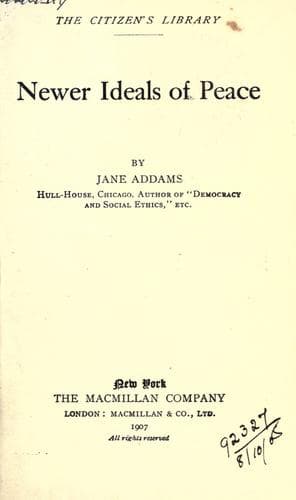
Municipal government -- United States; Peace; Political participation -- United States; Social justice; Working class -- United States
Out of the mediaeval city founded upon militarism there arose in the
thirteenth century a new order, the middle class, whose importance
rested, not upon birth or arms, but upon wealth, intelligence, and
organization. This middle class achieved a sterling success in the
succeeding six centuries of industrialism because it was essential to
the existence and development of the industrial era. Perhaps we can
forecast the career of woman, the citizen, if she is permitted to bear
an elector’s part in the coming period of humanitarianism in which
government must concern itself with human welfare. She will bear her
share of civic responsibility because she is essential to the normal
development of the city of the future, and because the definition
of the loyal citizen as one who is ready to shed his blood for his
country, has become inadequate and obsolete.
FOOTNOTES:
[15] A Case for the Factory Acts. Mrs. Sidney Webb.
CHAPTER VIII
PASSING OF THE WAR VIRTUES
Of all the winged words which Tolstoy wrote during the war between
Russia and Japan, perhaps none are more significant than these:
“The great strife of our time is not that now taking place between
the Japanese and the Russians, nor that which may blaze up between
the white and the yellow races, nor that strife which is carried
on by mines, bombs, and bullets, but that spiritual strife which,
without ceasing, has gone on and is going on between the enlightened
consciousness of mankind now awaiting for manifestation and that
darkness and that burden which surrounds and oppresses mankind.” In
the curious period of accommodation in which we live, it is possible
for old habits and new compunctions to be equally powerful, and it is
almost a matter of pride with us that we neither break with the old nor
yield to the new. We call this attitude tolerance, whereas it is often
mere confusion of mind. Such mental confusion is strikingly illustrated
by our tendency to substitute a statement of the historic evolution of
an ideal of conduct in place of the ideal itself. This almost always
occurs when the ideal no longer accords with our faithful experience
of life and when its implications are not justified by our latest
information. In this way we spare ourselves the necessity of pressing
forward to newer ideals of conduct.
We quote the convictions and achievements of the past as an excuse for
ourselves when we lack the energy either to throw off old moral codes
which have become burdens or to attain a morality proportionate to our
present sphere of activity.
Public-domain text, read in full here on John Shaqi.
Reviews
Reviews
No reviews yet
Be the first to share your thoughts on this work.
Elsewhere in the archive
Join the Discussion
Join the discussion
Sign in to leave a comment or review.
Sign InorCreate an account