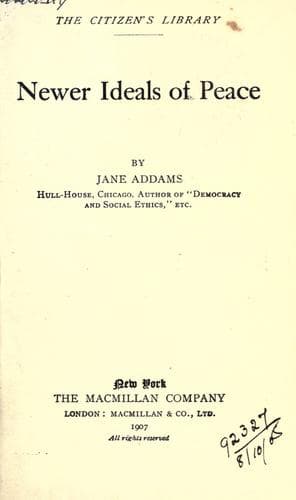
Municipal government -- United States; Peace; Political participation -- United States; Social justice; Working class -- United States
By way of illustration, I may be permitted to cite the London showman
who used to exhibit two skulls of Shakespeare--one when he was a youth
and went poaching, another when he was a man and wrote plays. There
was such a striking difference between the roystering boy indulging in
illicit sport and the mature man who peopled the London stage with all
the world, that the showman grew confused and considered two separate
acts of creation less improbable than that such an amazing change
should have taken place. We can easily imagine the gifted youth in the
little group of rustics at Stratford-on-Avon finding no adequate outlet
for his powers save in a series of break-neck adventures. His only
alternative was to sit by the fire with the village cronies, drinking
ale so long as his shillings held out. But if we follow him up to
London, through all the charm and wonder of the stage which represented
his unfolding mind, if we can imagine his delight as he gradually
gained the freedom, not only of that big town, but of the human city
as well, we can easily see that illicit sport could no longer attract
him. To have told the great dramatist the night Hamlet first stepped
upon the boards that it was a wicked thing to poach, to have cautioned
him that he must consider the cost of preserving the forest and of
raising the deer, or to have made an appeal to his pity on behalf of
the wounded creatures, would have been the height of folly, because
totally unnecessary. All desire, almost all memory of those days, had
dropped from him, through his absorption in the great and exciting
drama of life. His effort to understand it, to portray it, had utilized
and drained his every power. It is equally true of our contemporaries,
as it was of the great play-wright, that the attainment of this
all-absorbing passion for multiform life, with the desire to understand
its mysteries and to free its capacities, is gradually displacing the
juvenile propensities to warfare.
From this standpoint the advocates of the newer Ideals of Peace would
have little to do but to insist that the social point of view be kept
paramount, realizing at the same time that the social sentiments are as
blind as the egoistic sentiments and must be enlightened, disciplined
and directed by the fullest knowledge. The modern students of human
morality have told us that primitive man, by the very necessities of
his hard struggle for life, came at last to identify his own existence
with that of his tribe. Tribal life then made room within itself for
the development of that compassion which is the first step towards
sensibility and higher moral sentiment. If we accept this statement
then we must assume that the new social morality, which we so sadly
need, will of necessity have its origin in the social affections--we
must search in the dim borderland between compassion and morality for
the beginnings of that cosmopolitan affection, as it is prematurely
called.
Public-domain text, read in full here on John Shaqi.
Reviews
Reviews
No reviews yet
Be the first to share your thoughts on this work.
Join the Discussion
Join the discussion
Sign in to leave a comment or review.
Sign InorCreate an account