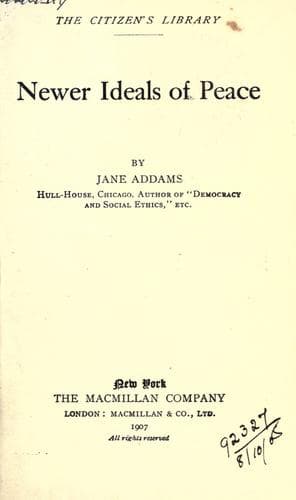
Municipal government -- United States; Peace; Political participation -- United States; Social justice; Working class -- United States
Speculative writers, such as Kant, Bentham, and Buckle, long ago
pointed out that the subsidence of war was inevitable as society
progressed. They contended that every stage of human progress is marked
by a further curtailment of brute force, a limitation of the area in
which it is permitted. At the bottom is the small savage community in
a perpetual state of warfare; at the top an orderly society stimulated
and controlled by recognized ideals of social justice. In proportion
as the savage society comes under the dominion of a common moral
consciousness, it moves up, and in proportion as the civilized society
reverts to the use of brute force, it goes down. Reversion to that
brute struggle may at any moment cost the destruction of the painfully
acquired bonds of equity, the ties of mutual principle, which are
wrought with such effort and loosed with such ease. But these earlier
philosophers could not possibly have foreseen the tremendous growth
of industry and commerce with their inevitable cosmopolitanism which
has so recently taken place, nor without knowledge of this could they
possibly have prognosticated the leap forward and the aggressive
character which the concern for human welfare has latterly evinced.
The speculative writers among our contemporaries are naturally the
only ones who formulate this new development, or rather bid us heed
its presence among us. An American philosopher[3] has lately reminded
us of the need to “discover in the social realm the moral equivalent
for war--something heroic that will speak to men as universally as war
has done, and yet will be as compatible with their spiritual natures
as war has proved itself to be incompatible.” It may be true that we
are even now discovering these moral substitutes, although we find
it so difficult to formulate them. Perhaps our very hope that these
substitutes may be discovered has become the custodian of a secret
change that is going on all about us. We care less each day for the
heroism connected with warfare and destruction, and constantly admire
more that which pertains to labor and the nourishing of human life.
The new heroism manifests itself at the present moment in a universal
determination to abolish poverty and disease, a manifestation so
widespread that it may justly be called international.
Public-domain text, read in full here on John Shaqi.
Reviews
Reviews
No reviews yet
Be the first to share your thoughts on this work.
Join the Discussion
Join the discussion
Sign in to leave a comment or review.
Sign InorCreate an account